

The CUORE experiment at Gran Sasso National Laboratory in Italy primarily searches for a radioactive process of 130Te, called neutrinoless double-beta decay. If observed, this process would confirm the Majorana nature of the neutrino and possibly constrain its absolute mass scale. Moreover, as a lepton-number-violating phenomenon, this decay could help explain why our universe is dominated by matter as opposed to antimatter.
CUORE has built an unparalleled cryogenics system to detect this hypothetical decay, whose signature would be a monoenergetic peak at the decay Q-value. The CUORE detector is a close-packed array of 988 TeO2 calorimeters capable of measuring energy in the form of vibrations when operated at ~10 mK; a custom, cryogen-free dilution refrigerator hosts the 742 kg detector. Because energy from other sources, including cosmic rays, natural radioactivity, and even environmental vibrations, can be picked up by the detector, its energy measurements must be as accurate and precise as possible to disentangle the neutrinoless double-beta decay contribution. To increase the CUORE sensitivity to the neutrinoless double-beta decay signal, LBNL NSD affiliates Bradford Welliver and Kenneth Vetter recently developed and implemented a noise-canceling algorithm to minimize the environmental noise in the CUORE data stream.
CUORE has been collecting data since 2017, and researchers now present a new lower limit on the half-life of their target decay using over 2 tonne.yr of TeO2 exposure, the largest dataset achieved by any solid-state detector. The analysis of this result was led by LBNL postdoc Krystal Alfonso, and Prof. Pranava Teja Surukuchi of the University of Pittsburgh. Members of the Berkeley CUORE group that contributed to the work include Dr. Brian K. Fujikawa (CUORE PI at LBNL) and Prof. Yury G. Kolomensky (CUORE PI at UC Berkeley), along with Prof. Eric Norman (UC Berkeley and NSD affiliate), LBNL staff scientist Sergio Zimmermann, graduate students Kenneth Vetter, Sachi Wagaarachchi, and Tong Zhu, postdoctoral scholars Mattia Beretta, Chiara Capelli and Erin Hansen, research scientists Vivek Singh and Bradford Welliver.
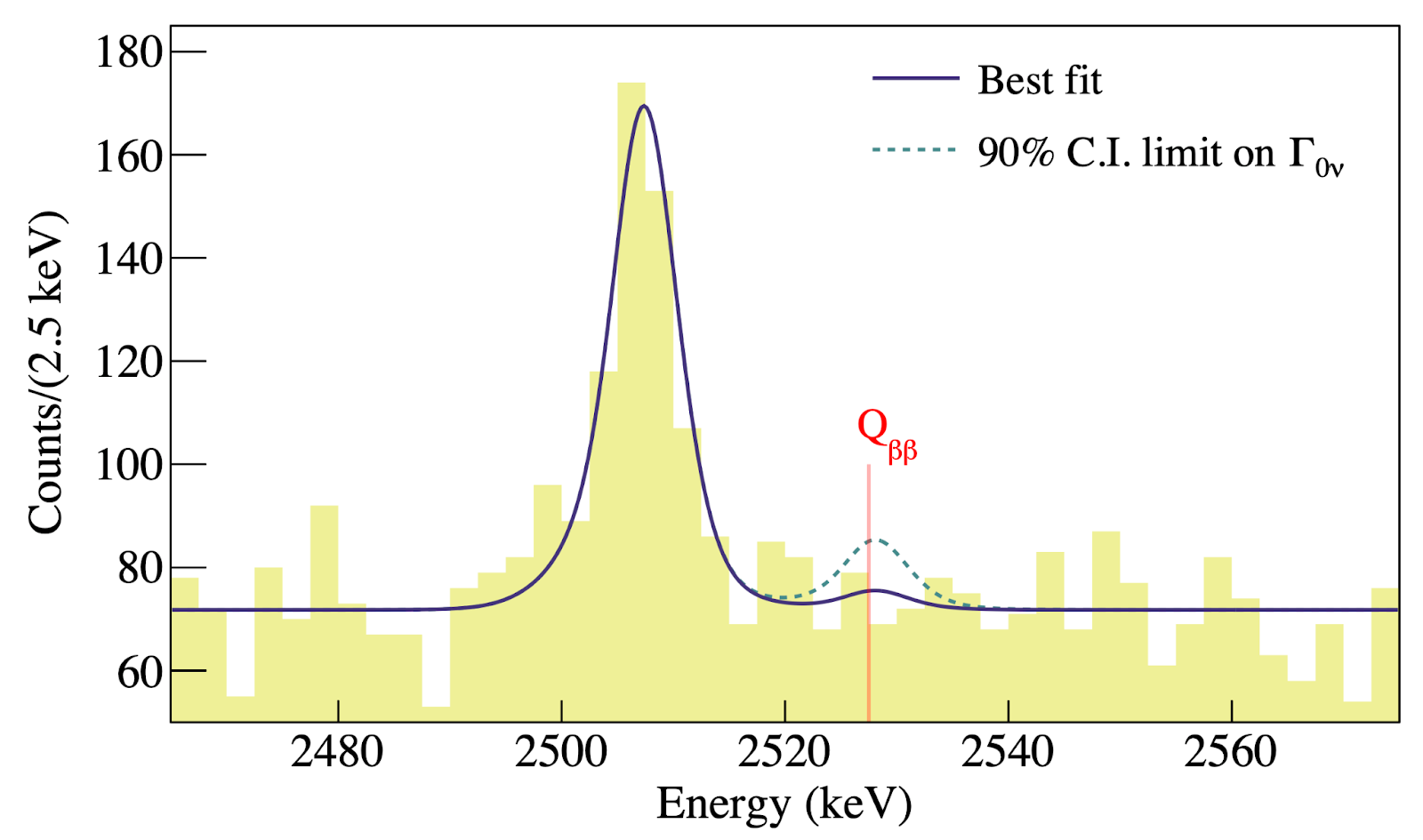
The best-fit curve (dark purple) and the best-fit curve with the neutrinoless double-beta decay rate fixed to the 90% C.I. limit (dashed green) to the energy spectrum (yellow) in the region-of-interest after all selection cuts.
References
- CUORE Collaboration, Constraints on lepton number violation with the 2 tonne · year CUORE dataset, Science 390, 1029-1032 (2025). DOI:10.1126/science.adp6474
