
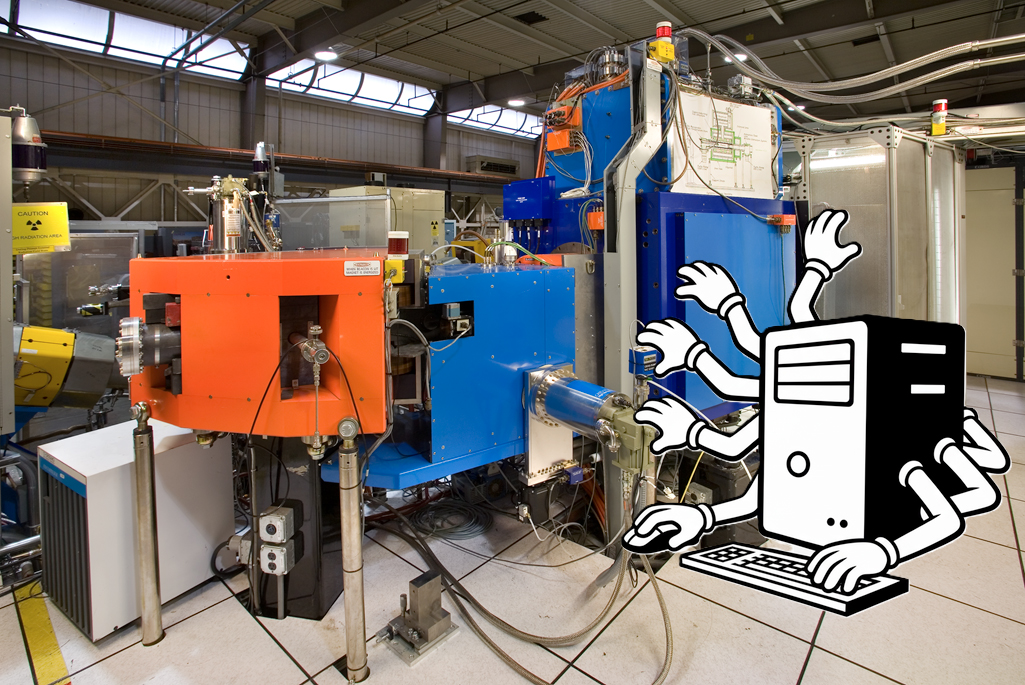
The fully-superconducting electron cyclotron resonance (ECR) ion source VENUS serves as the primary ion beam injector for the 88-Inch Cyclotron. Though in operation over 20 years, VENUS remains one of the world’s highest-performing sources for the production of high-current, highly-charged ion beams. VENUS is the prototype source for the Facility for Rare Isotope Beams (FRIB), where one near-copy constructed at LBNL is in use and two others are being constructed.
At VENUS’ heart is a magnetically-confined plasma from which ions are extracted and accelerated. Plasma stability can be difficult to achieve and sustain, and the source operator typically has 10-20 knobs to do this while maximizing beam production. In recent years, a team of researchers from 88 Operations, the Low Energy and Applied Nuclear Physics programs has been using machine learning (ML) techniques to optimize VENUS’ performance. Of particular interest are the high-current 50Ti beams that were used to demonstrate element 116 production and needed for the planned element 120 search. Titanium’s high reactivity makes source stability difficult, and isotope 50’s low abundance makes it expensive and motivates efficient utilization.
For a recent week, we left VENUS under complete automated control while the computer maximized beam current for a set titanium (abundant 48Ti) input. The computer used a Bayesian Optimization method developed by Building 88’s Victor Watson that maximizes source output while adhering to strict plasma stability requirements. This new algorithm has shown improvements in both avoiding parameter exploration space boundaries and more efficiently exploring the breadth of that space.
A central focus of the computer optimization was VENUS’ magnetic field operational range. This space is vast and tedious for humans to explore as typical superconductor coil current changes take minutes to complete. Setting the limitlessly-patient computer loose on the task led to it discovering a previously-unused operational field that resulted in a nearly 25% increase in titanium beam current compared to our typical (human-found) operation point, as can be seen in Figure 2.
So far as we understand, VENUS is the only ECR ion source that has been fully controlled and optimized by computer. It is expected that with more learning time for the computer, its tuning performance will push closer to world record beams.
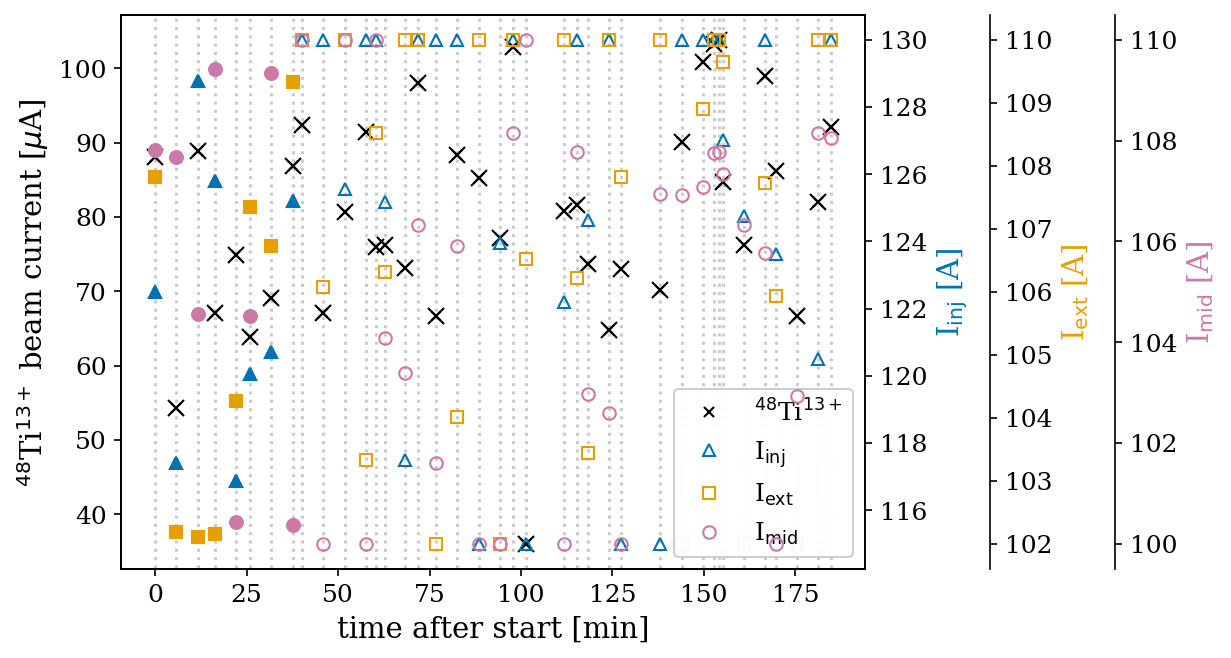
Figure 2: Results of a Bayesian Optimization of 48Ti13+, an affordable proxy for 50Ti13+, where VENUS’ superconducting solenoid currents are free parameters. Vertical dotted lines are visual guides for each explored coil setting and resulting current. The optimizer was initialized with eight random settings (solid points) and then optimized (hollow). The best achieved currents were 104 μA, while typical operational fields produced only 82 μA. (credit: Damon Todd)
