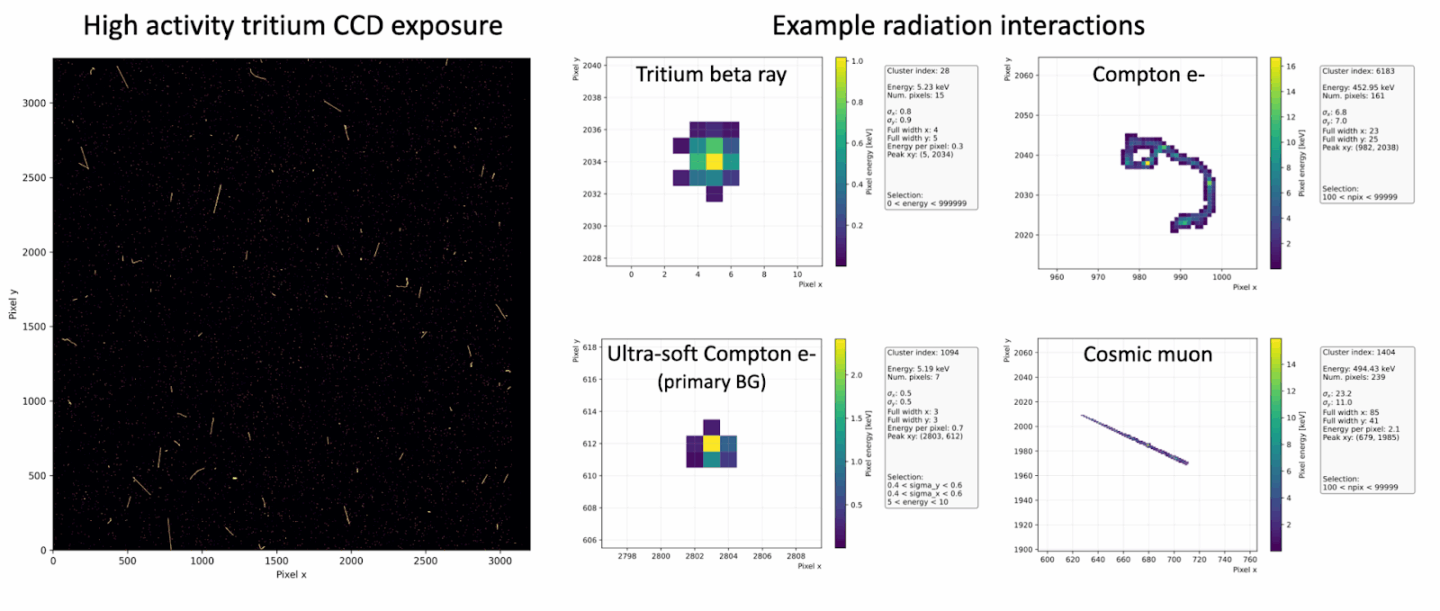
Tritium, an isotope of hydrogen with two extra neutrons, is an elusive but ubiquitous signature of human nuclear activities. As a proposed fuel for hypothetical fusion reactors, an important component in nuclear weapons, and a byproduct released in trace quantities by fission power plants, tritium is of essential interest for the environmental monitoring and nuclear nonproliferation communities. Detection of tritium, though, particularly in situ in the field, has been a notoriously difficult task. Chemically identical to hydrogen, it can only be detected via its radioactive decay. As tritium decays with an extremely feeble beta emission with energy less than 18 keV, its signature is simply too weak to penetrate into the sensitive volume of conventional detectors. Detection today requires great patience, and is only achieved with long counting times at laboratory-based ultra-low background proportional counters or single use liquid scintillator cocktails.
However, a new path forward has been identified in scientific grade Charge Coupled Devices (CCDs). Originally developed as optical sensors for astronomy, CCDs can carefully record light impinging from faint and distant objects across the universe, registering ionization down to single electrons. To astronomers, radiation signatures also picked up by the CCDs are a nuisance — “bogus” objects to be rejected. But as one scientist’s background is another scientist’s signal, CCDs have been recognized as extremely sensitive sensors for particle detection, too. Famously, they are the basis for the impressive DAMIC dark matter experiment, which waits for massive dark matter particles to gently nudge the silicon nuclei as they pass through Earth.
Tritium signatures are actually not so different from dark matter nuclear recoils, and it’s been recognized that CCDs could be applied for that domain, too. Attractive features of CCDs for tritium detection include their extremely low noise, fine pixelization, high dynamic range and resolution, and the triggerless nature of their operation. Special attention is also needed for the “entrance windows”, an inactive layer that can be made as thin as 10-100 nm to allow the beta rays to reach the sensitive volume. Altogether, these features allow CCDs to pick out extremely faint signals from particles with extremely limited penetration. And ultimately these sensors produce information-rich images that are ripe for exploitation with machine learning.
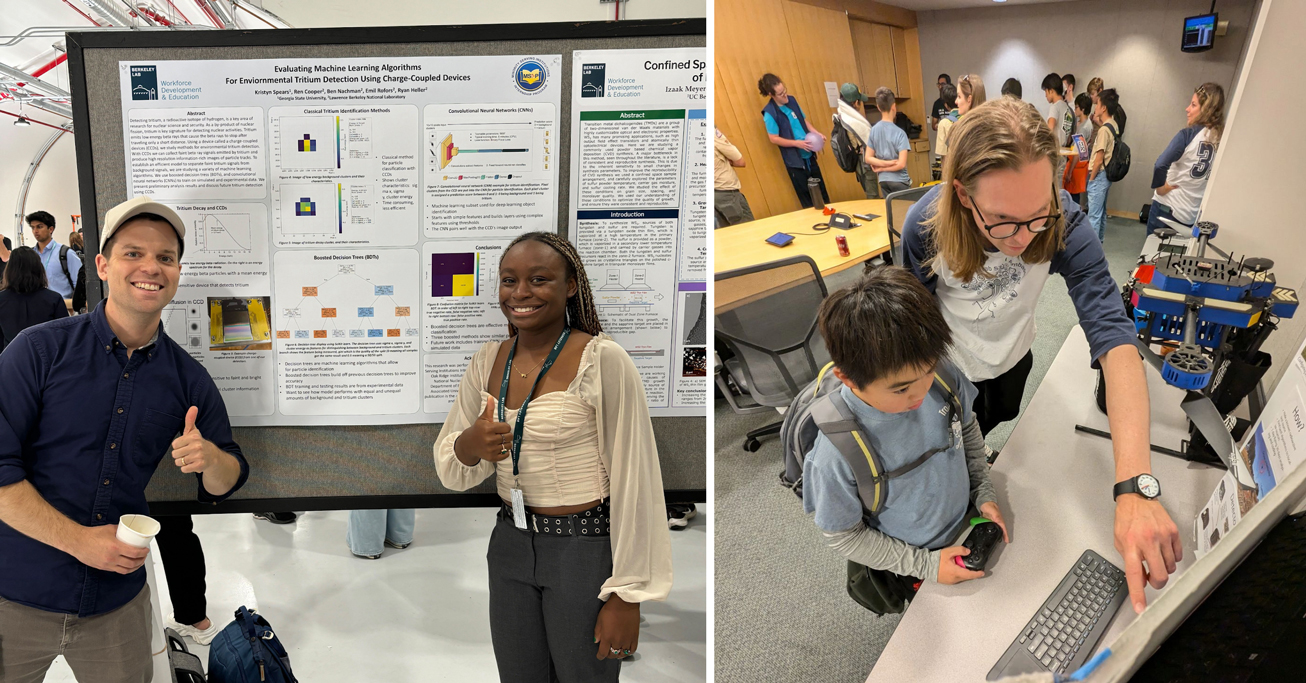
Enter the team at NSD, a trio of early career researchers: Emil Rofors, an expert in machine learning, radiation detection, and robotics; Ryan Heller, an expert in particle physics and silicon detectors; and Kristyn Spears, an NNSA MSIIP undergraduate intern from Georgia State University. Together the team has been investigating what level of tritium sensitivity can be achieved with CCDs, particularly leveraging enhancements from deep learning.
A variety of algorithms have been explored to sift through and pick out small traces of tritium from a significantly larger background. These include Convolutional Neural Nets, deep learners designed to ingest images and extract relevant features for classification. Algorithms from particle physics experiments have also been studied, including ParticleFlow, originally intended for classification of hadronic jets formed in high energy collider experiments. This approach is ideal for sparse datasets with permutation invariant elements, like a short set of activated pixels. These deep learning methods tend to outperform shallower classifiers like Boosted Decision Trees or simple parametric cluster analysis, at the expense of more exhaustive training requirements and larger sensitivity to slight variations in the experimental conditions. Multiple approaches together will have a place in a robust and sensitive detection system.
Based on analysis of simulated samples and preliminary experimental data, it looks promising to achieve sensitivity at the level of 2 mBq/µL in 24-hour counting experiments with small aqueous samples. This is well-aligned with the requirements anticipated for deployable field systems to monitor tritium gas concentrations in the air. The analysis work so far has been documented in a publication soon to be published in IEEE Transactions on Nuclear Science: https://arxiv.org/abs/2508.00532.
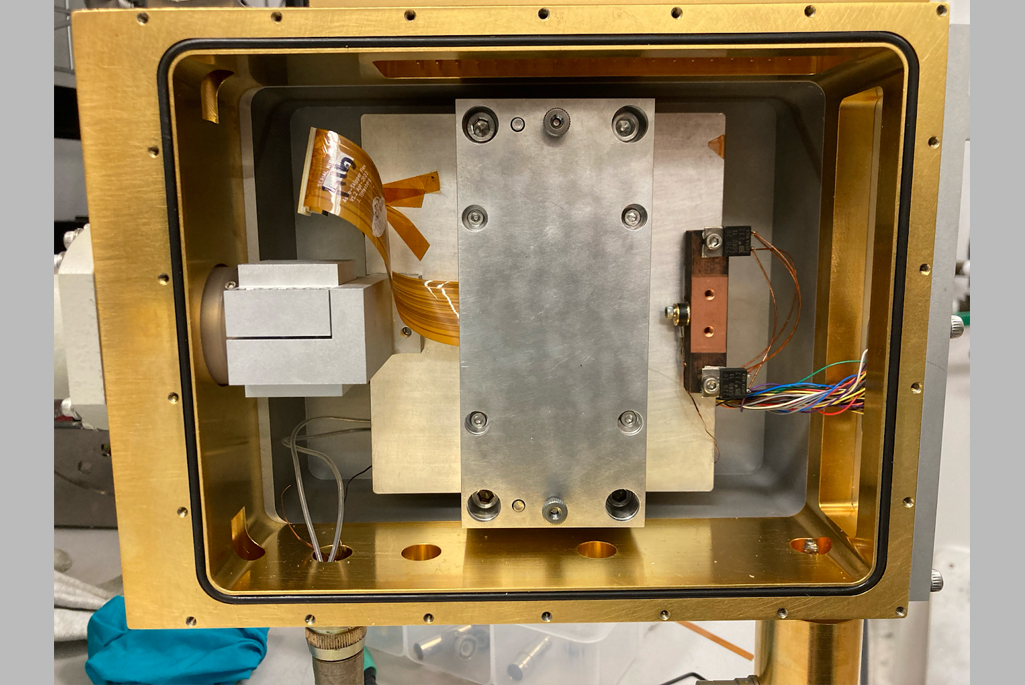
Further work is underway to validate these projections with an experimental CCD test stand being commissioned at LBNL with help by Armin Karcher from Engineering Division. The team hopes to continue this effort and develop a fieldable experimental system prototype that can reliably process tritium samples in situ. CCDs augmented with machine learning may lead the way to a new era of tritium detection!