
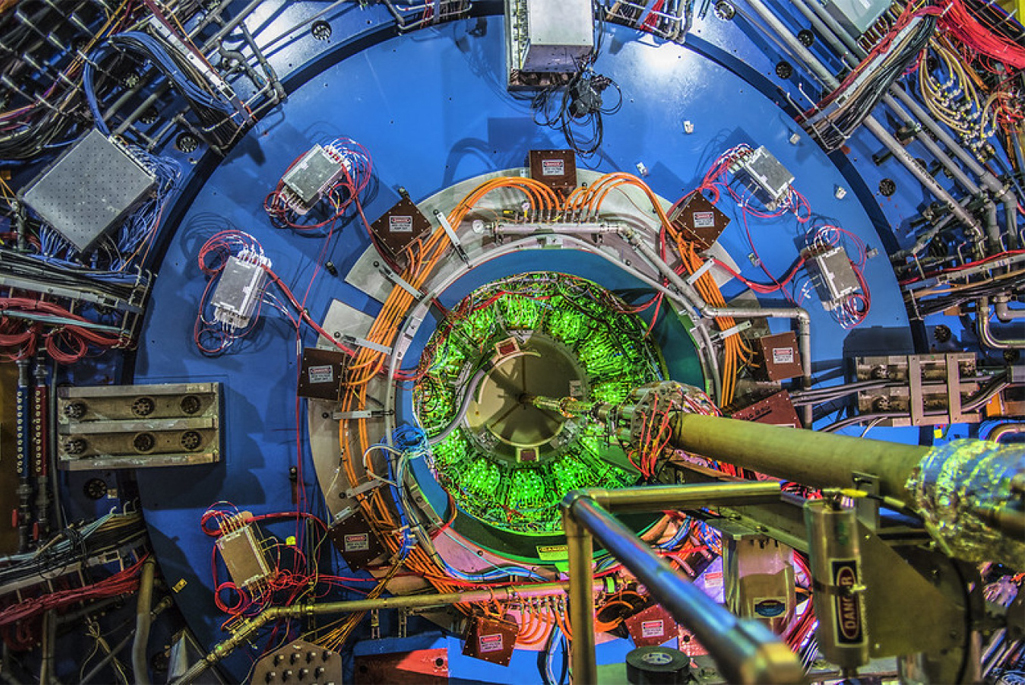
Ever since the Relativistic Heavy Ion Collider (RHIC) debuted in 2000, it’s been an essential and wonder-inspiring tool for understanding the building blocks of matter. Over the last 25 years, the results from RHIC – a DOE Office of Science User Facility – have surprised scientists over and over again. This DOE article provides a historic view on RHIC and its science.
From its initial conception to its final run, RHIC has expanded the world’s understanding of the very building blocks of our universe. Berkeley Lab scientists and engineers have been involved in the RHIC experiments from their inception until today. In particular, Berkeley Lab’s Nuclear Science Division (NSD) led the construction of the Time Projection Chamber and pioneered the application of MAPS-based silicon pixel detectors at the STAR experiment. Members of the NSD played the leading role in the first experimental observations of elliptic flow and jet quenching at STAR, which led to the discovery of the “perfect liquid”, the strongly coupled Quark Gluon Plasma (QGP). Currently members of the NSD are leaders in the study of the phase diagram of Quantum Chromodynamics (QCD), and in the measurements of jets and heavy flavors as probes of the QGP at STAR and sPHENIX experiments at RHIC.
