
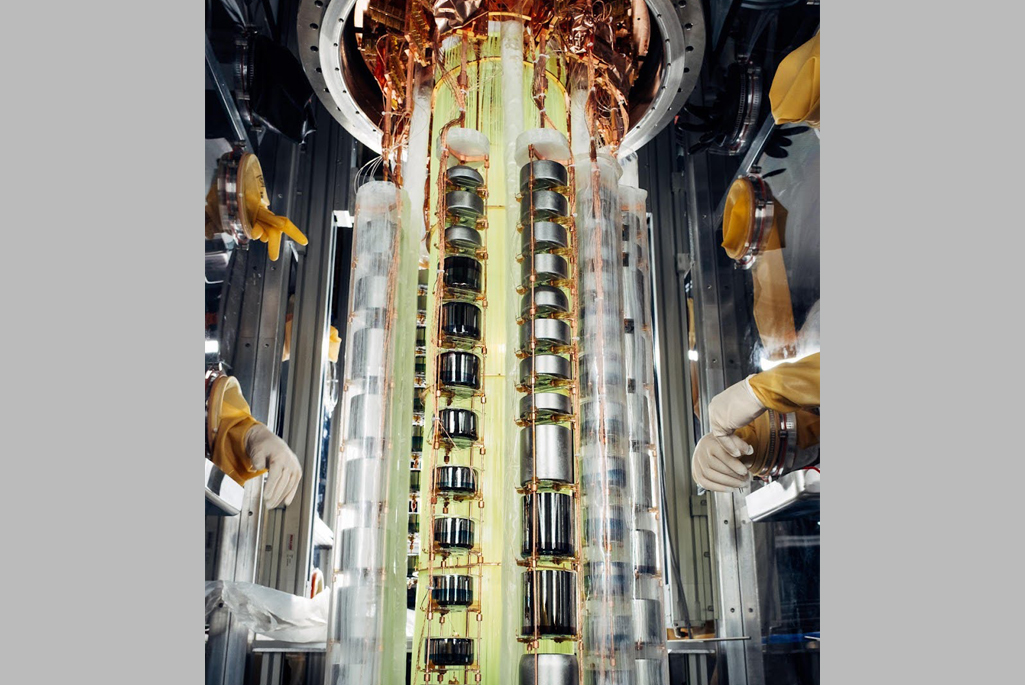
After the conclusion of the EU-led GERDA and the US-led MAJORANA DEMONSTRATOR (MJD) experiments, the two collaborations, along with additional experts in low-background neutrino research, joined forces to establish the LEGEND collaboration. Their first goal was to search for 0νββ decay in 76Ge by combining GERDA’s superior radioactive background rejection technology in liquid argon with MJD’s advanced ultra-pure material production techniques and signal readout electronics design in the first phase of the LEGEND experimental program — LEGEND-200.
By refurbishing GERDA’s infrastructure in Hall A of the Laboratori Nazionali del Gran Sasso (LNGS), the new collaboration could expedite LEGEND-200’s physics program. LEGEND-200 is anticipated to reach a 1027-year discovery sensitivity after 5 years of operation.
Building on its success in the MJD experiment, the LBNL LEGEND group, with personnel from the Nuclear Science and Engineering Divisions, designed and fabricated the signal readout electronics for the LEGEND-200 experiment. The front-end board — the Low-Mass Front-End (LMFE) — is the most radio-pure (i.e., low in radioactivity) electronics ever placed next to an active detector for 0νββ search. The performance of the signal readout electronics surpassed that of GERDA and is on a par with that of MJD. This article provides an overview of NSD’s contributions to LEGEND-200 when the experiment entered its production data-taking phase.
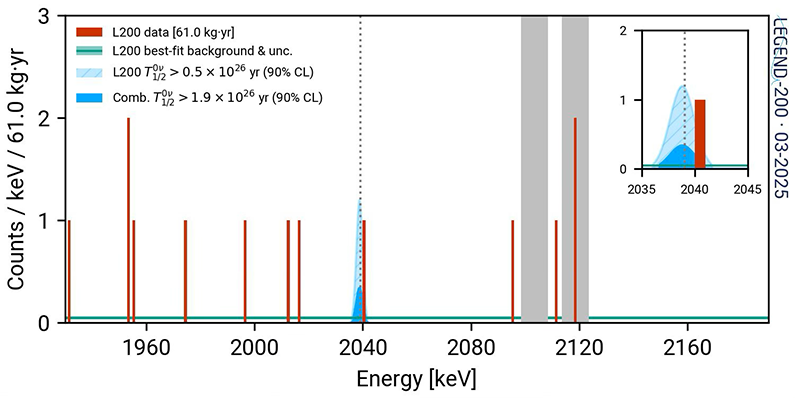
The first LEGEND-200 paper summarizes results from its first 61 kg·yr of exposure to 76Ge. The LEGEND Collaboration implemented a blind analysis scheme in which data within ±25 keV of the expected signal peak at the total decay energy (Qββ) of 2039.06 keV were kept inaccessible until the analysis procedures were finalized.
The golden data set, a subset of 48.3 kg·yr exposure of the most sensitive and stable detectors, reached an extremely low background index of approximately 0.5+0.3−0.2 cts/(keV ton yr). The silver data set with 12.7 kg·yr exposure, consisting mostly of semicoaxial detectors with weaker background rejection, reached a background index of 1.3+0.8−0.5 cts/(keV ton yr).
A combined analysis including previous data from the GERDA and MAJORANA DEMONSTRATOR experiments set a new world-leading lower limit on the 0νββ decay half-life of T1/2>1.9×1026 years (90% C.L.) in 76Ge, with a median sensitivity of 2.8×1026 years. This limit corresponds to an upper limit on the effective Majorana neutrino mass (mββ) in the range of 75–200 meV, depending on the nuclear model used.
After releasing the 61 kg·yr data, the LEGEND collaboration conducted a background study campaign to further reduce the background index. In this campaign, special background data were taken, and components were removed from the detector and radiometrically assayed. The LEGEND-200 detector has returned to taking production data in its search for 0νββ decay.
Looking ahead, LEGEND’s second phase—LEGEND-1000—successfully completed a Critical Decision-1 (CD-1) independent project review in November 2025 and is awaiting final CD-1 approval from the Department of Energy. The NSD team is partnering with the IC designers at LBNL’s Engineering Division to develop a new application-specific integrated circuit (ASIC) for signal readout in LEGEND-1000.
At LBNL, Rebecca Carney, Alexey Drobizhev, Alan Poon, Ann-Kathrin Schuetz, Marcos Turqueti, former project scientist Bjoern Lehnert, and former postdocs Lisa Schlueter and Michael Willers contributed to the LEGEND-200 effort.
References
[1] LEGEND Collaboration, First Results on the Search for Lepton Number Violating Neutrinoless Double-β Decay with the LEGEND-200 Experiment, Phys. Rev. Lett. 136 (2026) 2, 022701.
