
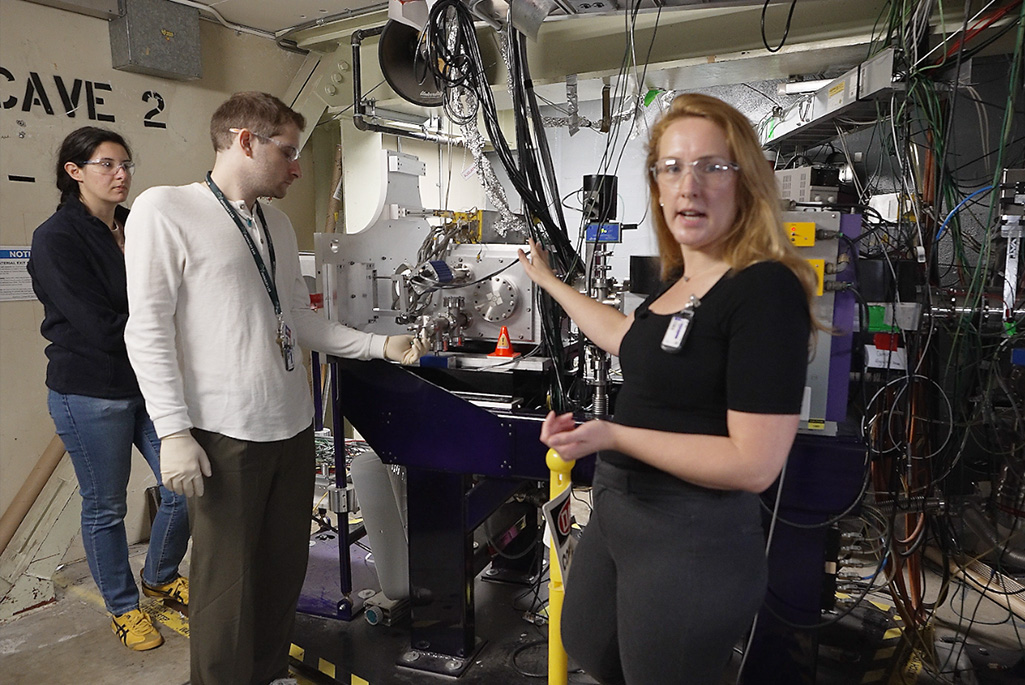
Does the periodic table need to be shaken up? To find out, researchers at Berkeley Lab’s Low-Energy Nuclear Physics Program are using FIONA—a state-of-the-art spectrometer at the Lab’s 88-Inch Cyclotron—to investigate the chemistry of the heaviest elements. Scientists suspect that the chemical behavior of superheavy elements may not follow the pattern implied by their current placement on the periodic table, and that new measurements could suggest it may be time to rethink this classroom staple.
At the moment, FIONA is the only instrument in the world capable of producing and identifying molecules that contain superheavy elements by measuring their mass, a key step toward confirming their chemical properties. FIONA stands for “For the Identification Of Nuclide A.” Here, “A” is a standard scientific symbol for the mass number—the total of protons (positively charged) and neutrons (no electric charge) in an atom’s nucleus.
FIONA also builds on Berkeley Lab’s long history of expertise with heavy elements, including the discovery of 16 elements and the 1944 reorganization of the periodic table by Glenn Seaborg, which introduced the actinide series. Seaborg’s revision not only highlighted the chemical properties of elements he discovered, but also made the table more predictive for elements that had not yet been found. Could another new rearrangement driven by research at Berkeley Lab be on the horizon?
Learn more:
- New Technique Sheds Light on Chemistry at the Bottom of the Periodic Table
August 4, 2026 / Lauren Biron / Berkeley Lab News Center
FIONA to Take on the Periodic Table’s Heavyweights
May 3, 2017 / Glenn Roberts Jr. / Berkeley Lab News Center
