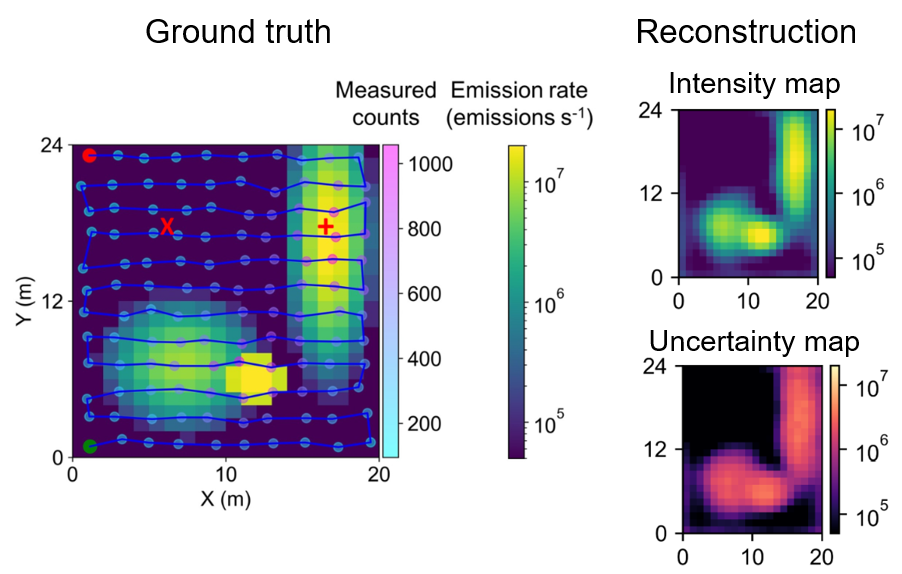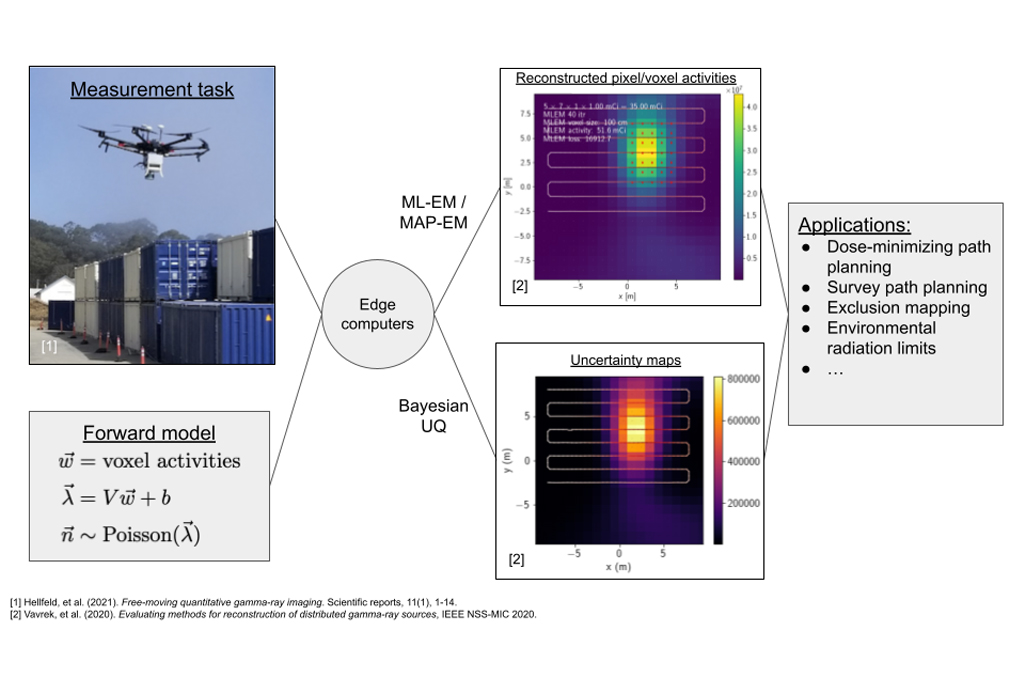
When radiation is detected in the environment, responders need to know not just the dose rate at a particular location, but the full mapping of the contamination distribution and an estimate of how uncertain that map is. A newly submitted study led by researchers in the Applied Nuclear Physics program in the Nuclear Science Division shows that a fast machine learning approach can provide both.
The study applies a method called Microcanonical Langevin Monte Carlo, or MCLMC, to radiological mapping. In simple terms, the method reconstructs a map of radioactive material based on detector measurements while estimating the uncertainty across the map. This is an improvement over conventional reconstruction methods that typically produce only a single best estimate, without indicating where the map is reliable and where more data is needed. The method was tested on both synthetic and real radiological mapping data, where it produced accurate radiation maps and uncertainty estimates.
The researchers found that their MCLMC approach can be much faster than comparable MCMC sampling-based methods. For the test run on synthetic data, MCLMC takes 13 seconds while another MCMC sampling method, Hamiltonian Monte Carlo, takes 474 s. When GPU-accelerated, MCLMC reaches good convergence in ~10 seconds for real-world wide-area radiation mapping measurements, making near-real-time uncertainty quantification much more practical for field applications.
The work was led by Lei Pan, Jaewon Lee, Brian J. Quiter, and Jayson R. Vavrek of Berkeley Lab’s Nuclear Science Division, in collaboration with Jakob Robnik and Uroš Seljak at UC Berkeley. The work is also part of the broader Bayesian Uncertainty Quantification consortium led by Nuclear Science Division scientist Peter Jacobs as PI, which supports Bayesian uncertainty quantification and machine-learning-enabled methods across multiple nuclear science research areas.