
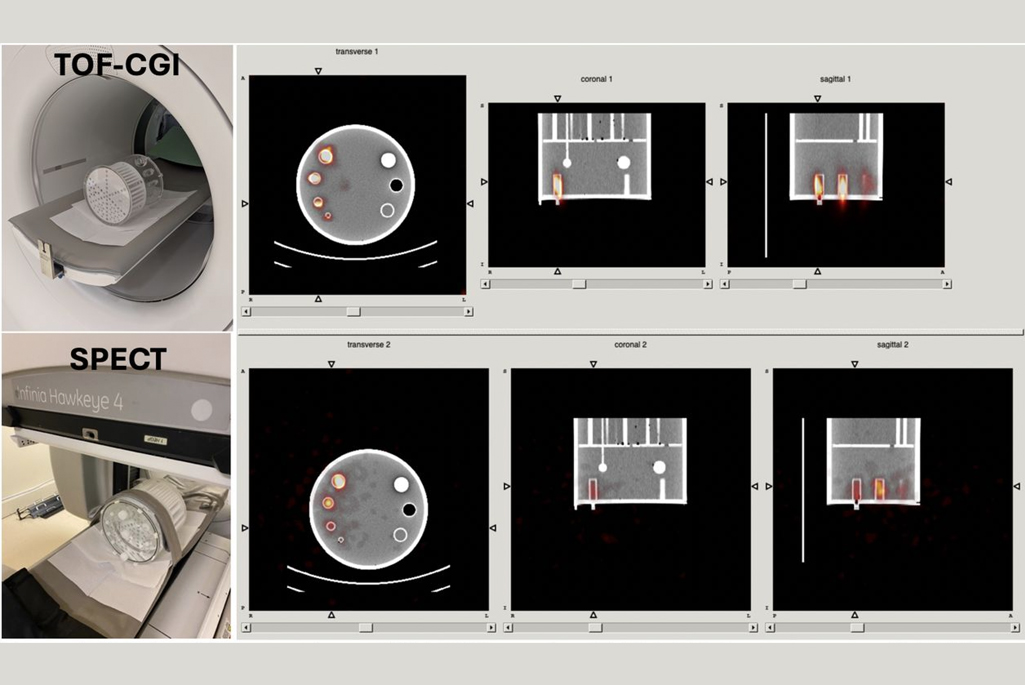
Alpha theranostics using Actinium-225 (Ac-225) offers immense promise for personalized cancer therapies. However, tracking the distribution of Ac-225 and its free-floating daughter isotopes, in the patient’s body has been a significant clinical challenge. Traditional SPECT imaging struggles with this task due to low injected activities and the high energy of the main gamma-rays.
A recent pilot study presented at the annual meeting of the Society of Nuclear Medicine and Molecular Imaging introduces a game-changing solution: Time-of-flight cascade gamma-ray imaging (TOF-CGI). Researchers successfully visualized the Ac-225 decay cascade in a standard clinical TOF-PET scanner without the need for traditional collimators.
The results of the study are remarkable. TOF-CGI yielded a high central sensitivity of 76.6 cps/MBq and a significantly superior signal-to-noise ratio (SNR) compared to standard SPECT. The resulting images exhibited notably less noise and higher contrast. Ultimately, this technique enabled the first quantitative tomography of a non-positron emitter using a TOF-PET scanner.
This milestone opens new doors for tracking theranostic radionuclides that emit cascade gamma-rays—such as Ac-225, Pb-212, and Lu-177—paving the way for more accurate monitoring of individualized cancer treatments. The first clinical images of Ac-225 imaging using the TOF-CGI technique were recently acquired and are expected to be published soon.
