
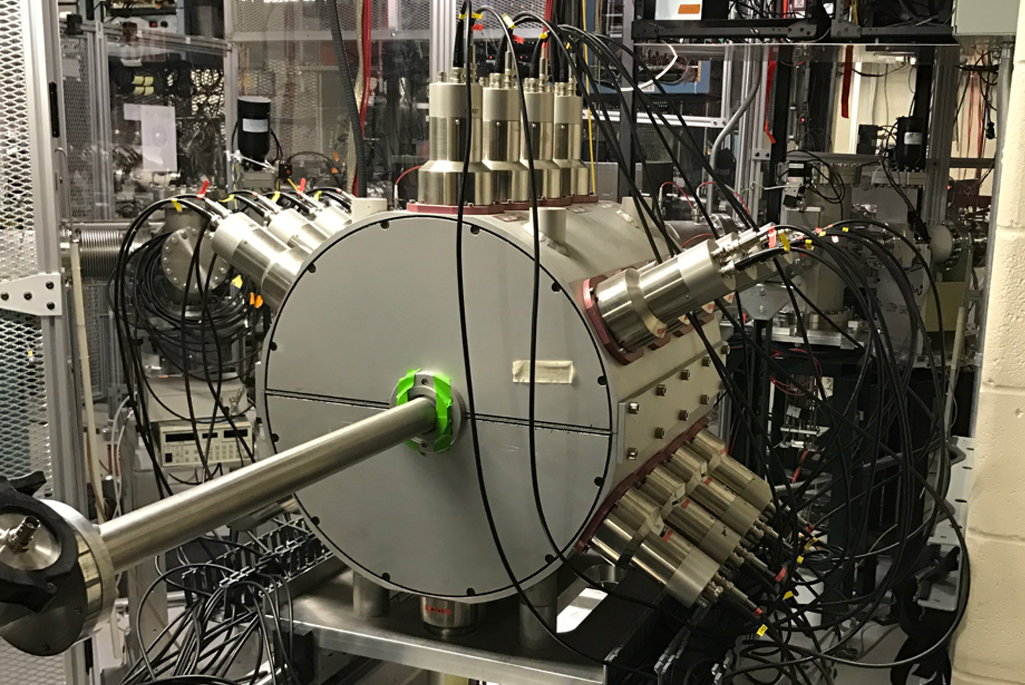
Mathis Wiedeking, a Nuclear Science Division scientist who led Berkeley Lab’s involvement in this effort, has played a leading role in the study of the low-energy enhancement since its early experimental confirmation at the 88-Inch Cyclotron. In 2012, Berkeley Lab researchers provided one of the first definitive demonstrations that the enhancement was a real physical phenomenon, motivating new theoretical and experimental studies. More recently, Mathis Wiedeking developed the model-independent Shape Method used to determine gamma-ray strength functions and contributed to the present Nature study, which establishes the magnetic character of the low-energy enhancement for the first time. LBNL continues to lead investigations using the GRETINA detector array to explore the behavior of the enhancement at the lowest gamma-ray energies and its implications for nuclear structure and nuclear astrophysics.
Magnetic clues inside atomic nuclei help explain how elements form in stars
July 15, 2026 / FRIB News
