

Advances in artificial intelligence and machine learning (AI/ML) hold promise to dramatically advance progress in both experimental and theoretical nuclear physics. Underlying such progress is the need for the comprehensive nuclear physics datasets required to train AI/ML models. This data is diverse, ranging from terabytes of raw event data from experimental devices to the results of complex nuclear theory calculations carried out at high-performance computing facilities. The goal of the Data Providers Program PD4M (Physics Data For Machines) project is to provide the tools and software infrastructure to produce fully contextualized data to train physics-based models across nuclear physics applications. The project falls under the DOE Genesis mission to accelerate discovery across the sciences. PD4M is led by LBNL, involving staff from the Nuclear Science Division, ESnet, and Engineering, with collaborators at ANL, FRIB, and ORNL.
Central to PD4M is the use of data labelers which are co-located with the experiment or computational facility. In the case of experiments, these data labelers ingest experimental data directly from the instrument as it is collected and output the data as key/value pairs in data formats suitable for training AI/ML systems. These can simply be extracted from the raw data itself, or from the results of a complex calculation, or inferred from an intermediate AI/ML model. Furthermore, this labeled data is directly associated with metadata collected in the experiment to provide context. Examples of such data might be the settings of the instrument(s), the temperatures of the detectors, or textual annotations a scientist makes during the experiment. This allows training on multiple facets of the data. Currently, we are beginning with labelers deployed on two large-scale gamma-ray spectrometers, GRETA and Gammasphere, sited at FRIB and ANL, respectively, and look to expand in the future to other instruments.
The data from large-scale theory calculations are also used for model training, but the workflows here are more varied and complex. To support this, theory codes utilize an SDK (Software Development Kit) provided by PD4M to populate an activity graph. Here, data primitives defined by the user, such as raw calculated results, the codes involved, and definitions of concepts, can be related. This activity graph can be queried and made available to training of models. An initial implementation of this system has been deployed with the ismrg++ code, which computes nuclear observables, running on Frontier at OLCF/ORNL.
Supporting both theory and experiment, the ultimate goal of the PD4M project is to support the training of a suite of models to enable ‘self-driving’ experiments through accelerating analysis and closing the theory-to-experiment loop.
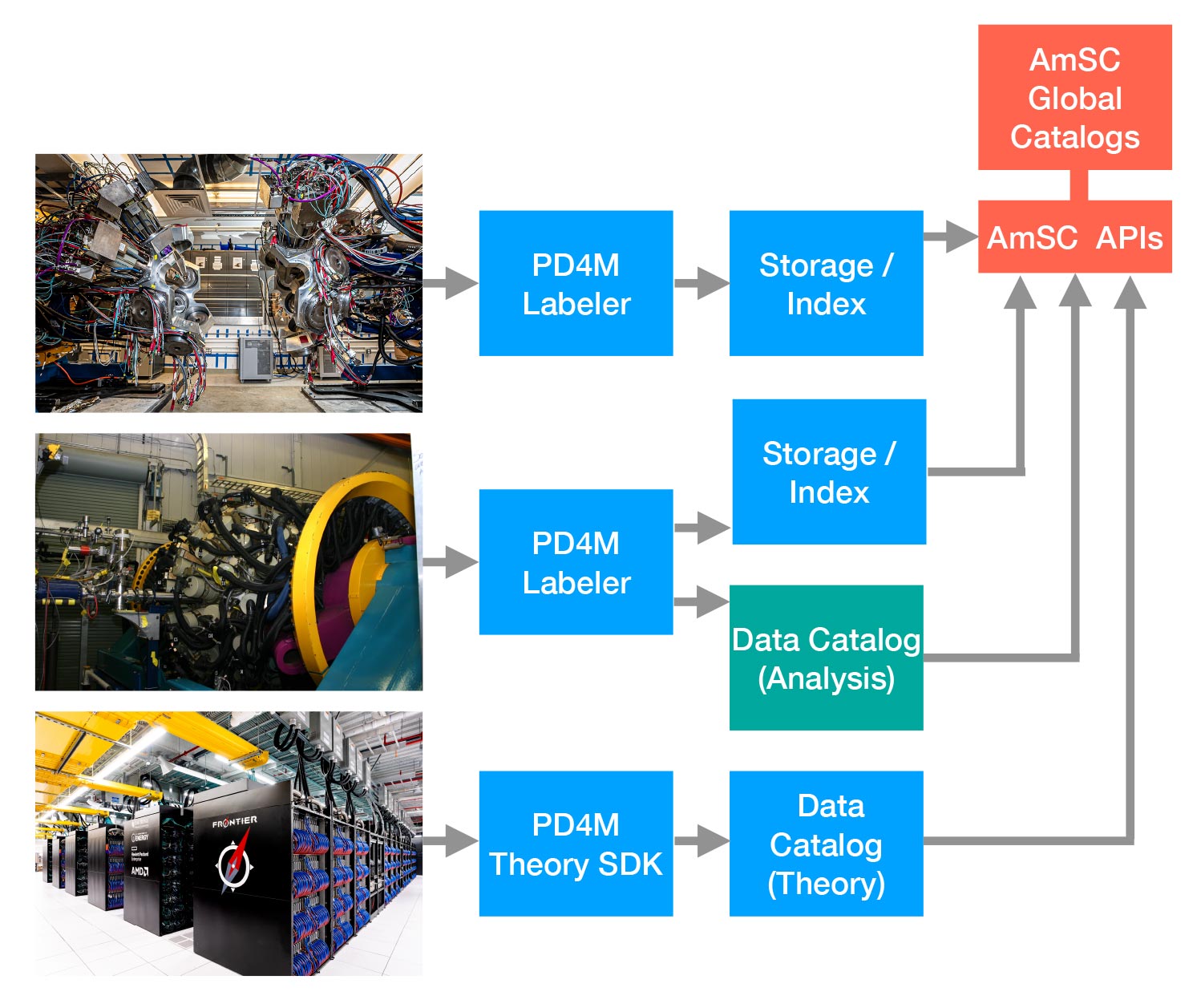
Block diagram of PD4M showing experimental devices (GRETA, Gammasphere) and theory codes (Frontier) with PD4M labelers, the theory SDK, data catalogs with the AMSC API.
