
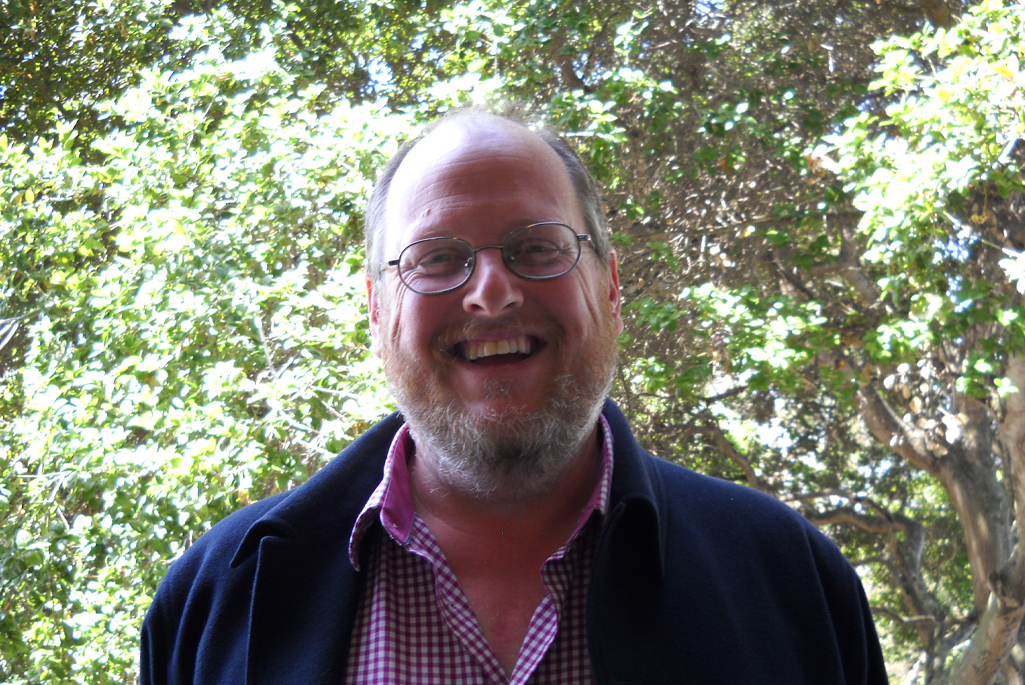
Roderick (Rod) Clark, a senior scientist and group leader in the Nuclear Science Division (NSD) at Lawrence Berkeley National Laboratory (Berkeley Lab) and a leading figure in the nuclear physics community, passed away suddenly on December 29, 2025; he was 56. Rod was a pillar of the NSD, of Berkeley Lab, and the international nuclear physics community over the last 30+ years. His scientific career was characterized by distinguished accomplishments and a passion for physics. Among his many leadership roles, Rod was acting NSD Division Director from 2013-2014 and chair of the Laboratory Staff Committee.
Rod Clark was born in Bristol, England on November 20th, 1969. He obtained a B.Sc. in Theoretical Physics at the University of York in 1990 and went on to graduate with a Ph.D. in experimental nuclear physics in 1993. His graduate thesis work included the first identification of a new class of collective rotational states (“shears-bands”) that led to more than a decade of experimental and theoretical studies by many groups world-wide.
Rod began his career at Berkeley Lab in 1994 as a postdoc in the NSD working in the Nuclear Structure Group alongside Frank Stephens and Dick Diamond. He quickly established an independent research program with a focus on the development and physics of the Gammasphere detector array through the late 1990s and early 2000s, leading studies on a variety of topics including studies of superdeformation, the shears mechanism, and critical point behavior. He was promoted to staff scientist in 1997 and advanced to the position of Senior Staff Scientist in 2011.
Rod’s work on the shears mechanism, a novel form of nuclear rotations that generates magnetic dipole transitions (also called magnetic rotations), is arguably one of the top highlights in nuclear structure physics to emerge during the “1990’s Gammasphere decade”. His series of precision measurements provided the definitive evidence for this phenomenon and, together with Augusto Macchiavelli, Rod developed a phenomenological model to describe its underlying microscopic origin and co-authored the review article that remains the definitive reference for this topic. His discovery of a new region of superdeformation (2:1 ellipsoid axis ratio) in cadmium nuclei was a significant advance in the study of deformed shell structure at high angular momentum, providing some of the best data so far to guide future experiments aiming to observe hyperdeformed nuclei (3:1 ellipsoid axis ratio). In his exploration of phase transitions and critical point symmetries in nuclei Rod applied these ideas to the nuclear pairing phase, using a simple collective Hamiltonian to describe the transition from a normal to a superconducting state.
In the 2000s, Rod started a highly successful program of research to study isomeric states in trans-actinide nuclei with efforts both at the 88-Inch Cyclotron at Berkeley Lab as well as the ATLAS facility at Argonne National Laboratory. His research into multi-quasiparticle isomeric states and rotational structures in the heaviest nuclei has and will continue to have a significant impact on the field. Continuing his interest in the heaviest elements, Rod recognized an opportunity to initiate a search for a new element at the 88-Inch Cyclotron. In 2019 he led the proposal for a US-led new-element search, which established a scientifically and technically credible path towards this goal. The Berkeley Lab-led team is moving ahead with plans to begin this new era of superheavy element science at Berkeley Lab within the next year.
In 2015, Rod was elected as a Fellow of the American Physical Society, “for his contributions to our understanding of superdeformation, his decisive measurements providing firm evidence of the shears mechanism in atomic nuclei, and his recent studies of the structure of isomeric states in heavy elements.”
Rod was actively engaged across the low-energy nuclear physics community. He served on program advisory committees at TRIUMF and ATLAS (ANL), including as chair of both committees. He was active over many years in the Nuclear Structure Conference series, chairing the 2010 conference held in Berkeley, and the Exotic Beam Summer School, which he organized at Berkeley Lab in 2013, furthering the science and development of future leaders. Within Berkeley Lab, Rod served as the acting NSD Division Director in 2013-2014, following James Symons appointment to the Physical Sciences Area ALD, and continued as NSD Deputy Division Director from 2015-2017. His service to the broader Berkeley Lab community included over 10 years of service on the Berkeley Lab Staff Committee, including 7 years as chair. He most recently served on the Project Management Advisory Board for science and engineering projects (PMAB-SE).
Rod had an extraordinary capacity to condense discussions to the essential physics and present them in a concise and erudite manner. His friends and colleagues will remember Rod as someone truly passionate about the science he pursued, with the ability to readily engage those around him in his enthusiasm. He supervised numerous postdocs over his career, guiding young researchers into the field he loved so much.
Rod is survived by his wife Anna, his son Brody (Broderick), his (step-)daughter Tahryn, grand-daughter Marlo and his brother Fraser.
