
![Adapted from [1].](https://nuclearscience.lbl.gov/wp-content/uploads/sites/4/2026/03/2026-BLDS-NEWS-IMAGE-1025x685px-KleinIncident.jpg)
High-energy photoproduction is a traditional tool to probe the partonic (quarks and gluons) structure of nuclei. The highest energy photoproduction reactions are ultra-peripheral collisions between the relativistic nuclei that are circulating at CERN’s Large Hadron Collider. Now, RNC senior scientist Spencer Klein, former UC Berkeley postdoc Minjung Kim, Creighton University Professor Janet Seger, and graduate student Neha Devi have used this data for another purpose: probing the structure of mesons that are produced via photoproduction, to try to resolve an old puzzle. It has long been known that four charged pions couple to a resonance with a mass around 1.5 GeV/c2, called the ρ’ or ρ(1600). For many years, this was thought to be a single resonance. But, some newer global analyses of multiple final states support a composite model with two overlapping resonances.
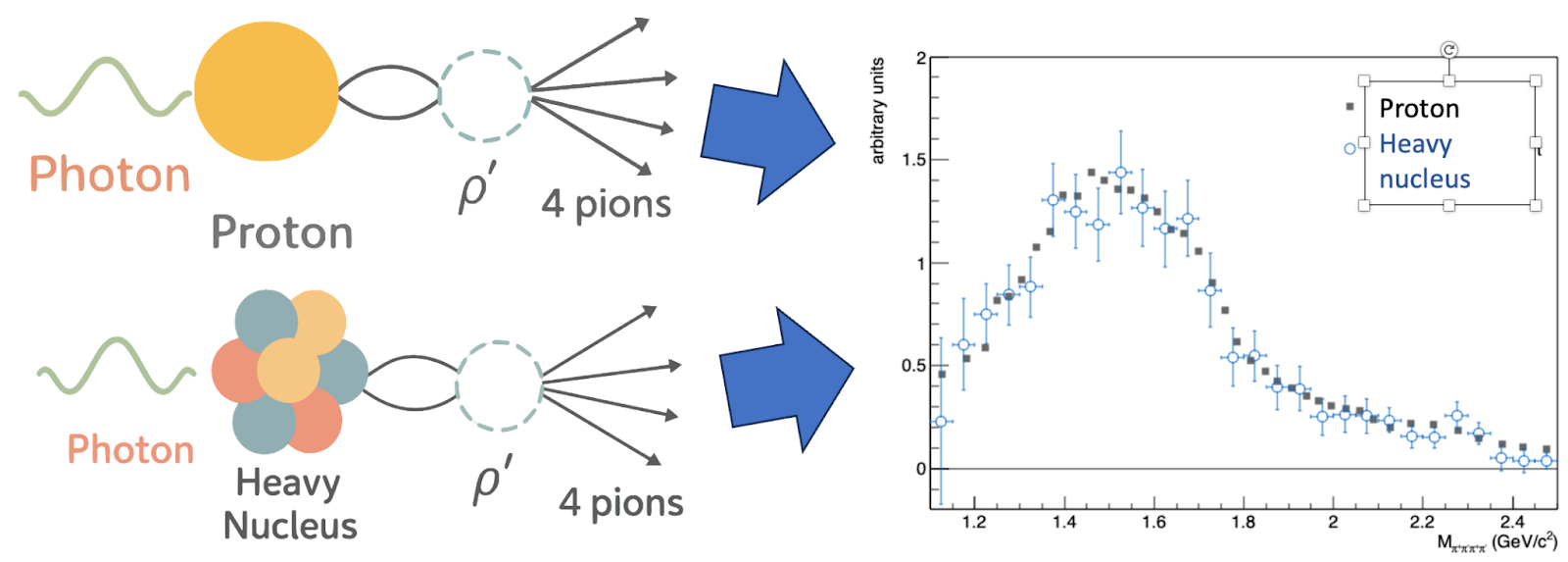
The new analysis supports the single-resonance model. It compared the four-pion mass spectrum from photon-proton and photon-lead interactions, finding that they were the same. The cross sections depend on the photon-meson coupling, meson-nucleon scattering cross section and the meson branching ratio into four pions. If the ρ’ were a composite of two resonances, they would be unlikely to have combinations of these elements that give the same relative cross sections on proton and lead targets. With different relative cross sections, the combined resonance shape would be different for the two targets. The identical spectra are most easily explained if ρ’ is a single resonance. The same comparison found that the ρ’ branching ratio into four pions is likely more than 10%.
The paper also explored ρ’ production at the Electron-Ion Collider (EIC). By studying multiple decay modes of the ρ’, the EIC will be able to provide a definitive answer to the ρ’ puzzle. ρ’ data may also be useful for studies of the gluonic structure of nuclei at low Bjorken-x. Its intermediate mass probes nuclear structure at intermediate Q2 (spatial resolution) where saturation effects should be between those of the ground state ρ and J/Ψ.
Reference
[1] Neha Devi, Janet Seger, Minjung Kim and Spencer Klein, Photoproduction and detection of 𝜌′→𝜋+𝜋−𝜋+𝜋− decays in ultraperipheral collisions and at an electron-ion collider, Physical Review C 113, 015207 (2025). DOI:https://doi.org/10.1103/wpbg-h511
