
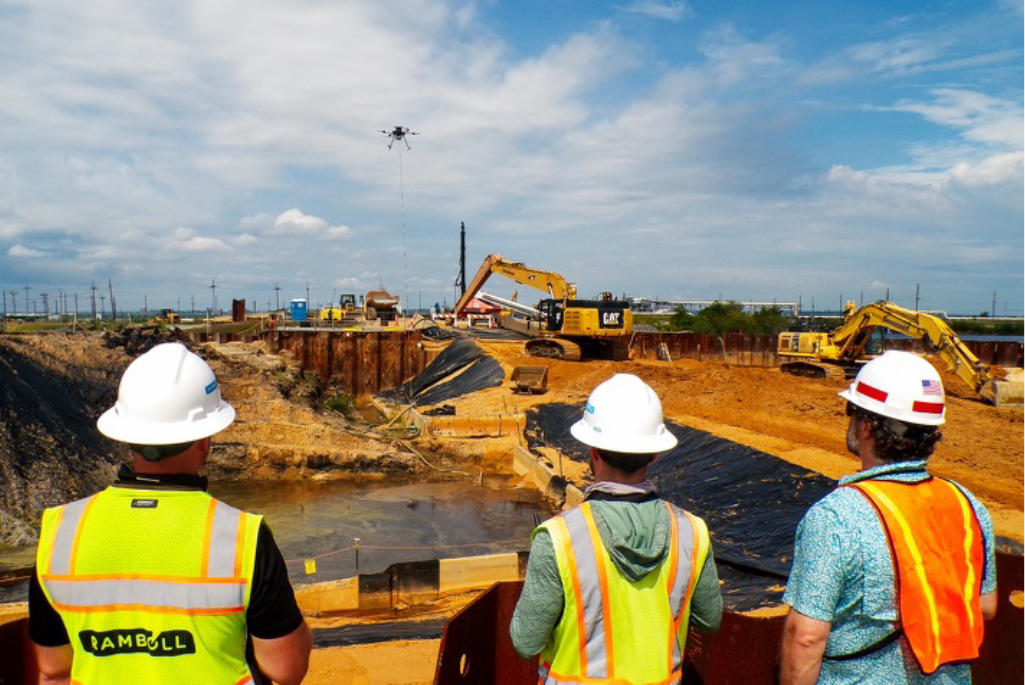
Last month, a team of Applied Nuclear Physics (ANP) researchers tested their prototype drone suspended gamma detector systems at the former DuPont Chambers Works site in Deepwater, New Jersey. The gamma detectors are being developed to help the US Army Corps of Engineers (USACE) confirm removal of uranium contaminated material that is legacy waste from refining activities that occurred during the Manhattan project.
The detector system is suspended from the drone using an 8m long tether in order to allow it to be close to the potentially contaminated material while the drone remains well clear of the excavation which improves drone ease of control and provides a margin of safety. Having the radiation detector close to the surveyed material is important because of the stringent contamination clean-up requirements that are being adhered to by USACE as part of the Formerly Utilized Sites Remedial Action Program (FUSRAP). In addition to the novel payloads, ANP has developed methods that leverage the non-negative matrix factorization technique to improve sensitivity of the gamma detectors to the uranium contamination and has teamed with UC Berkeley to create new drone controller logic that compensates for the known pendulum motion of the payload to stabilize payload trajectories while we confirm cleanup at the bottom of the remediation excavations.
