
With the generous support from the Nuclear Science Division (NSD) and the Lab (LBNL), NSD Sr. Scientist Feng Yuan spent his recent Professional Research or Teaching (PRT) leave at premier research institutions on the East Coast and Europe, including Columbia University/Brookhaven National Lab, University of Tubingen, Germany, and CEA/Saclay, Paris, France. During this time, Feng collaborated with experts working at the frontier of hadron physics, in particular, on the physics that are crucial for the future EIC.
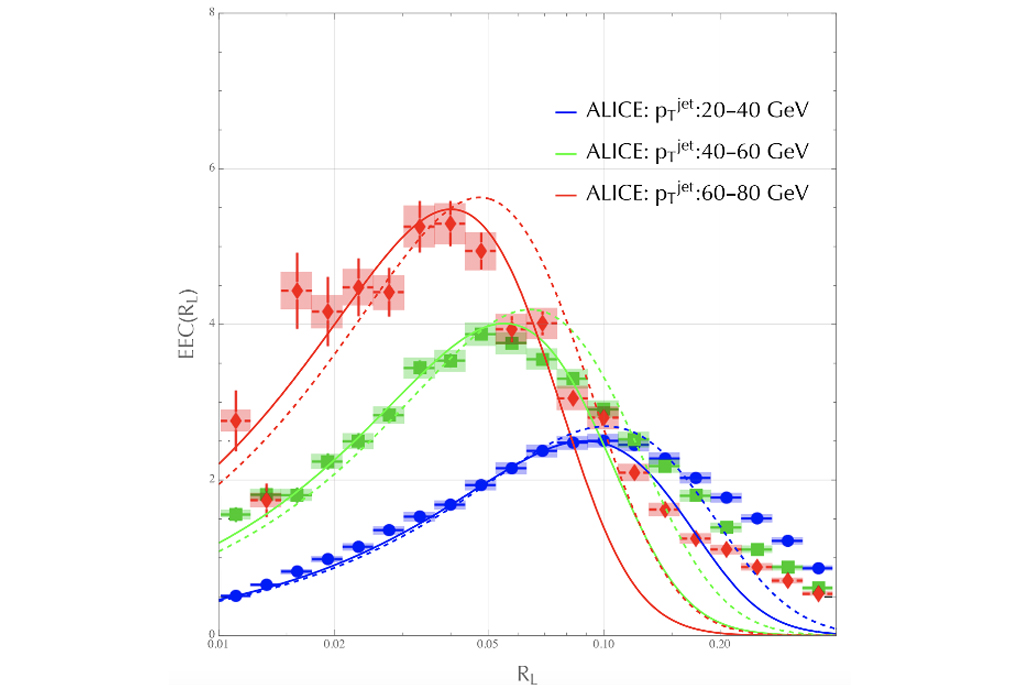
The journey started in June, 2024, at Tubingen, a small but charming university town near Stuttgart in southwest Germany. The town is quiet, but the place is full of energy in research related to EIC. Feng’s former collaborator, Werner Voglesang, leads a large group at the University of Tubingen working on frontier hadron physics of RHIC spin and future EIC precision probes. One of the projects Feng worked on at Tubingen concerns the energy-energy-correlators (EEC) at colliders. A remarkable universality of the correlator in the transition from the “free-hadron” region to the perturbative collinear region [1] is observed. This observation unveils the universal behavior of hadronization in jets when the pair of hadrons are close to each other. The results will play an important role in the study of the hot QCD matter effects of EEC in jet in heavy ion collisions as well.
The image in Fig. 1, which is taken from a paper Feng published during his PRT leave, shows a comparison between the universal model predictions (curves, depending on the fractions of quark/gluon contributions) for the energy-energy correlators in jets and the ALICE measurements extracted from ALICE.

Figure 1: Comparison between the universal model predictions (curves, depending on the fractions of quark/gluon contributions) for the energy-energy correlators in jets and the ALICE measurements extracted from ALICE, S. Acharya et al., (2024), 2409.12687.
Feng’s second stop was at Columbia University/Brookhaven National Laboratory, working with Al Mueller (Columbia), Raju Venugopalan (BNL) and Yoshitaka Hatta (BNL). This collaboration focused on studying diffractive processes in ultra-peripheral collisions (UPC) at RHIC/LHC and future EIC. In particular, the collaboration focused on vector meson production, dilepton production in UPC of heavy ion collisions, semi-inclusive diffractive deep inelastic scattering at the EIC. These researches will help to unveil the tomography imaging of gluonic matter in nucleon/nucleus at small-x.
The final stop was in Paris, the SPhT Saclay, France. With the support from FBF (France-Berkeley Fund) in 2023, Feng started a new collaboration with colleagues at Saclay and his visit this spring served to further strengthen this collaboration. Together with Edmond Iancu, Al Mueller and Paul Caucal (Nante), Feng worked on the semi-inclusive deep inelastic scattering at next-to-leading order in the color-glass-condensate formalism [2]. This process is one of golden channels to probe small-x gluon saturation at the EIC. Their study will lay a solid foundation for the future measurements and stimulate following-up investigations. It may also deepen the understanding of QCD factorization at extreme high density of gluon distributions. This will make jet observable easier for the DIS processes at the future EIC. Further theoretical and phenomenological developments are anticipated along this direction.
Inspired by the discussions with his hosts and participants from a workshop at Mainz in July 2024, the group have also worked on an interesting topic: quantum entanglement in high energy scattering processes at colliders. Their study focused on the so-called Nucleon-Energy-Energy-Correlators (NEEC), where long-range azimuthal angular correlations in proton–proton collisions at the LHC can provide a unique opportunity to explore the quantum entanglement [3]. In particular, the spinning gluon in these collisions will introduce substantial nonzero cos(2ϕ) asymmetries in both Higgs boson and top quark pair productions. This emerges as a pivotal avenue for delving into quantum entanglement and scrutinizing the Bell inequality at high-energy colliders.
References
[1] Xiaohui Liu , Werner Vogelsang, Feng Yuan, and Hua Xing Zhu, Universality in the Near-Side Energy-Energy Correlator, Phys. Rev. Lett. 134, 151901 (2025)
[2] Paul Caucal, Edmond Iancu, A. H. Mueller, and Feng Yuan, Jet definition and transverse-momentum–dependent factorization in semi-inclusive deep-inelastic scattering, Phys. Rev. Lett. 134, 061903 (2025)
[3] Yuxun Guo , Xiaohui Liu , Feng Yuan, and Hua Xing Zhu, Long-Range Azimuthal Correlation, Entanglement, and Bell Inequality Violation by Spinning Gluons at the Large Hadron Collider, Science Partner Journal, Research, Vol 2025, Article ID: 0552
