
Understanding how massive stars explode as supernovae has been a central challenge in nuclear astrophysics for decades. When a star exhausts its nuclear fuel, its core collapses into a neutron star, producing the extreme conditions needed for heavy element nucleosynthesis.
How this process unfolds is a long standing question. In a scenario originally proposed by Bethe and Wilson, neutrinos streaming from the hot proto-neutron star heat overlying material, driving a shockwave. In spherically symmetric (1D) models, however, the neutrinos generally fail to reverse the collapse and the explosion fizzles.
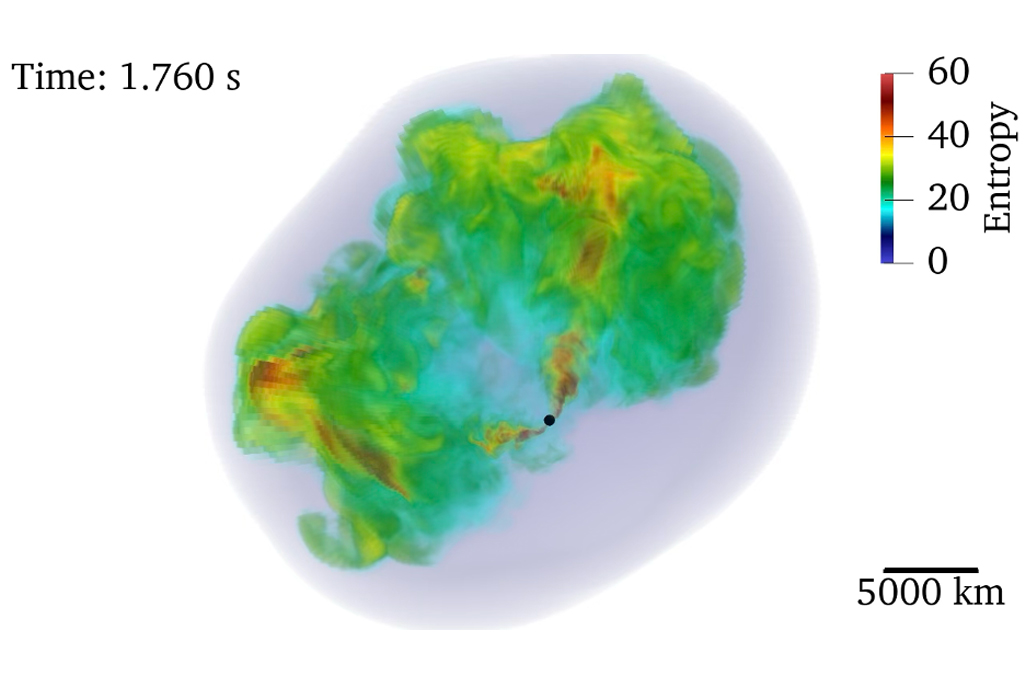
Now, using modern supercomputing capabilities, 3D simulations are finally realizing successful neutrino-driven explosions. Fig. 1 shows a simulation run by postdoc David Vartanyan and Tianshu Wang, working with NSD’s Daniel Kasen. In 3D, neutrino heating drives turbulent convection, facilitating energy transport; the explosion spontaneously develops highly asymmetric plumes, dramatically influencing the dynamics and nucleosynthesis.
While 3D simulations have typically captured only the first few seconds of the explosion, the recent work Vartanyan et al. (2025) [1] reaches a new milestone, simulating the event out to month timescales and bridging spatial scales from the 10’s of km of a proto-neutron star to the expelled debris cloud the size of the solar system.

Figure 1: Simulation of the explosion of a 40 solar mass star, 1.7 seconds after collapse. The rendered entropy shows regions heated by the expanding shock wave and/or neutrino heating. The development of turbulent convection and global asymmetry facilitate a successful explosion.
Intense computing and multiple simulation codes were required. The Fornax neutrino-hydrodynamics code (developed by Adam Burrows at Princeton) modeled the explosion phase. Post-processing with nuclear reaction networks determined nucleosynthetic yields, and the FLASH hydrodynamics code simulated the shock wave ripping through the entire star. The Sedona radiation code predicted the gamma rays to infrared emission from the radioactive debris.
These “whole shebang” simulations can now be compared directly to observations, including light curves, spectra, and elemental distributions seen in SN remnants. The models strongly resemble real Type II SNe, and allow one to study ejecta mass, energetics, and nucleosynthetic yields (see Fig. 2). The ejecta morphology imprints distinct nuclear pathways — e.g., 56Ni forming in material in nuclear statistical equilibrium is separated from 44Ti emerging from alpha-rich freeze-out in sustained neutrino-irradiated flows.
Such simulations are possible due to enhanced computing capabilities developed under programs like the DOE Exascale Computing Project and its ExaStar project led by Kasen at LBNL. Computational nuclear astrophysics is now entering a new era — instead of just trying to get the models to explode, we have a predictive framework that can study how nuclear microphysics (e.g., dense matter equation of state, neutrino interactions, nuclear reaction rates) plays out on astronomical scales, explaining the diverse explosions in the sky and the heavy elements they produce.

Figure 2: Predicted electromagnetic signals from the 3D supernova simulations. The left panel shows the bolometric luminosity (as seen from different viewing angles) which carries information on the explosion energetics and radioisotope yields. The right panel shows the synthesized optical spectrum (observed 80 days after collapse) compared to a real observed event. The line features can be used to diagnose the abundance of isotopes ejected in the explosion.
References
[1] D. Vartanyan, B. Tsang, D. Kasen, T. Wang, A. Burrows, L. Teryoshin, “A 3D Simulation of a Type II-P Supernova: From Core Bounce to beyond Shock Breakout”, The Astrophysical Journal, Volume 982, Issue 1 (2025). DOI: 10.3847/1538-4357/adb1e4
