
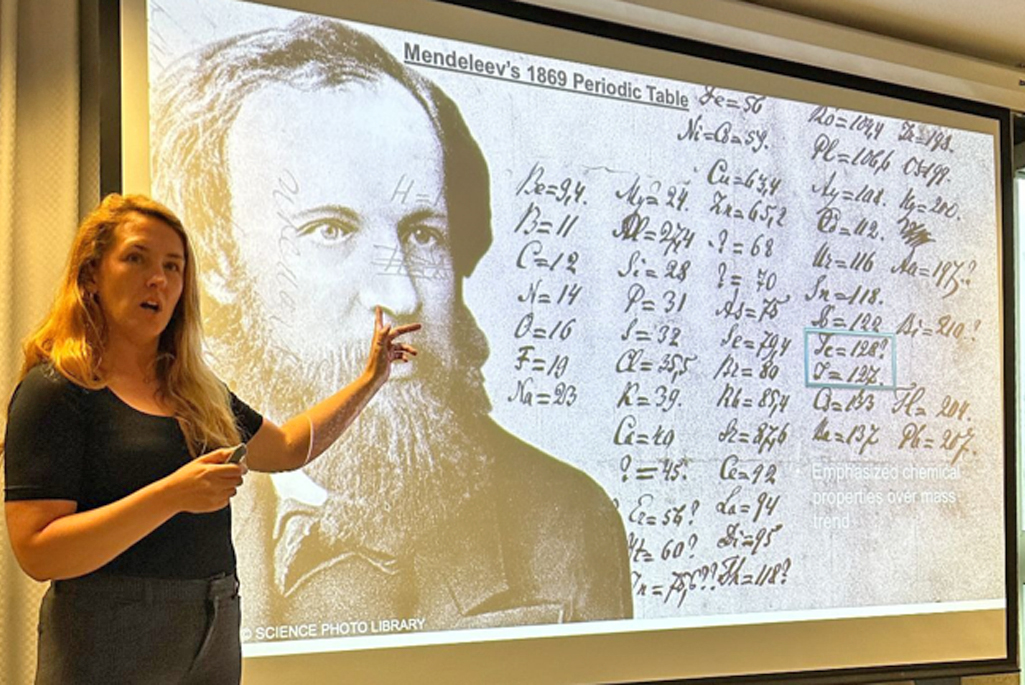
The modern periodic table creates the illusion that chemistry is a solved puzzle. With every row and column of the table filled — either by atoms studied for centuries or man-made ones observed only a few times — the story of the elements appears to be complete. For a student first learning chemistry the table is a guide, with an element’s position determining its chemical behavior. But this is likely not true for the superheavy elements at the very bottom of the table. These behemoths may have unusual chemical properties that the periodic table does not reliably predict. A question emerges: is there a way to rearrange the periodic table to accurately reflect the chemical properties of superheavy elements and make it predictive once again?
The chemical properties of the superheavy elements are expected to break from the framework of the periodic table due to the onset of enhanced relativistic effects [1]. These relativistic effects can change how readily electrons in superheavy elements form molecules with other atoms. For example, the last element on the periodic table, Oganesson (Og, Z = 118), is positioned as a noble gas, but may in fact behave more like a semiconductor material willing to give up electrons [2]. It may instead be Coppernicum (Cn, Z = 112) or Flerovium (Fl, Z = 114) that displays the chemical properties of a noble gas [3, 4]. Unfortunately, it is very difficult to study these predictions experimentally. Superheavy elements do not exist naturally on earth and need to be produced one atom at a time in nuclear reactions. Currently, very few places in the world have the technology and expertise to study these elements, and even when studies have been conducted the results are usually qualitative in nature. We do not yet have enough detailed information on the chemical properties of these elements to know where they should reside on the periodic table.
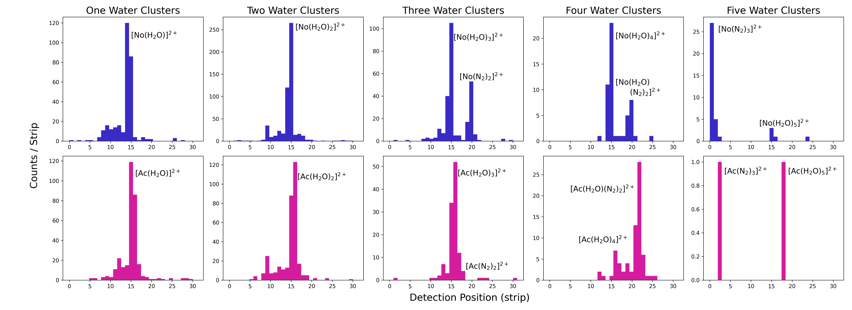
A new program led by Jennifer Pore (Nuclear Science Division) and the Heavy Element Group at the 88-Inch Cyclotron Facility is using the FIONA spectrometer to unlock the secrets of superheavy element molecules. The observed formation of specific molecules can directly reflect the electronic structure of the superheavy elements available to do chemistry. By identifying these species via their mass-to-charge ratio — a world-first — the team is poised to gain unprecedented insight into the chemistry of the heaviest elements. This capability was recently demonstrated in a landmark Nature publication in August 2025, detailing the identification of the first molecular species of nobelium (No, Z = 102) [5]. To carry out this vision, Dr. Pore was recently awarded a prestigious DOE Early Career Award, jointly funded by the DOE’s Office of Nuclear Physics and the Office of Basic Energy Sciences. The ambitious program is set to begin its first measurements in the summer of 2026.
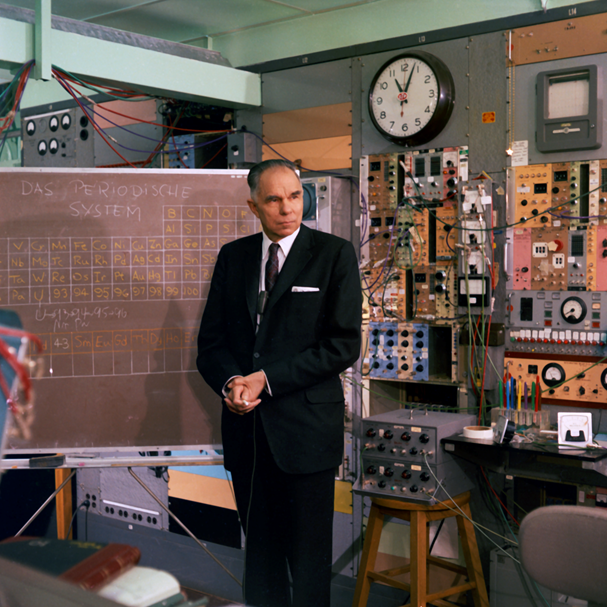
The organization of the periodic table follows a proud tradition at Berkeley Lab. In 1944, Glenn T. Seaborg proposed a radical reorganization of the periodic table to include the actinide series (from Actinium, Z=89, to the then undiscovered element Z=103) [6]. This change restored the table’s predictive power, and as new elements were discovered their properties aligned precisely with his predictions. In looking beyond his actinide series, Seaborg noted that “we may be in danger of using the periodic table incorrectly” when considering superheavy elements, suggesting that “atom-at-a-time chemistry would need to advance far beyond what can be imagined today” to resolve the uncertainty [7]. Now, Dr. Pore and the NSD Heavy Element team are ready to begin the next chapter. With the power of the 88-Inch Cyclotron, another Berkeley Lab reorganization of the periodic table may be on the horizon —reminding today’s students that chemistry is far from a solved problem.
References
[1] Smits, Odile R., Christoph E. Düllmann, Paul Indelicato, Witold Nazarewicz, and Peter Schwerdtfeger. “The quest for superheavy elements and the limit of the periodic table.” Nature Reviews Physics 6, no. 2 (2024): 86-98.
[2] Smits, Odile R., Jan‐Michael Mewes, Paul Jerabek, and Peter Schwerdtfeger. “Oganesson: A noble gas element that is neither noble nor a gas.” Angewandte Chemie International Edition 59, no. 52 (2020): 23636-23640.
[3] Eichler, Robert, N. V. Aksenov, A. V. Belozerov, G. A. Bozhikov, V. I. Chepigin, S. N. Dmitriev, R. Dressler et al. “Chemical characterization of element 112.” Nature 447, no. 7140 (2007): 72-75.
[4] Yakushev, A., L. Lens, Ch E. Düllmann, J. Khuyagbaatar, E. Jäger, J. Krier, J. Runke et al. “On the adsorption and reactivity of element 114, flerovium.” Frontiers in chemistry 10 (2022): 976635.
[5] Pore, Jennifer L., Jacklyn M. Gates, David A. Dixon, Fatima H. Garcia, John K. Gibson, John A. Gooding, Mallory McCarthy et al. “Direct identification of Ac and No molecules with an atom-at-a-time technique.” Nature 644, no. 8076 (2025): 376-380.
[6] Seaborg, Glenn T. “Origin of the actinide concept.” Handbook on the Physics and Chemistry of Rare Earths: Lanthanides/Actinides: Chemistry 18 (1994).
[7] Seaborg, Glenn T. “Evolution of the modern periodic table.” Journal of the Chemical Society, Dalton Transactions 20 (1996): 3899-3907.
