
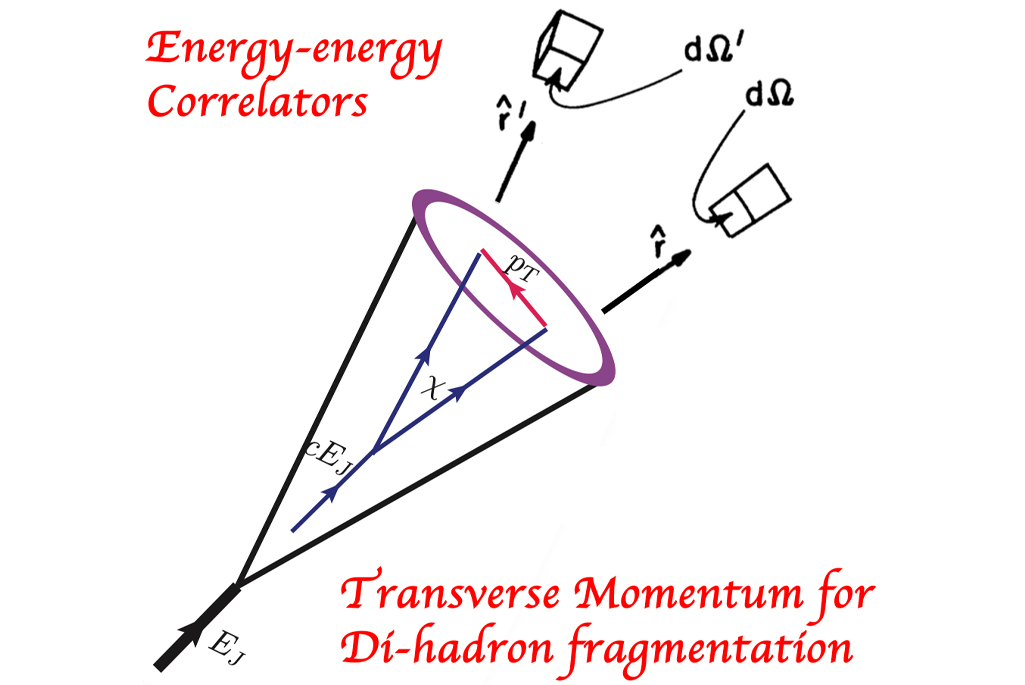
Energy-energy correlators (EECs) have a long history in high energy physics, where a correlation is measured between two energy flows of final state particles with an opening angle [1]. It was proposed at the end of the 1970s to test the strong interaction theory of quantum chromodynamics (QCD). Renewed interest in recent years has led to a suite of new measurements across different colliders, including the Relativistic Heavy Ion Collider (RHIC), the Large Hadron Collider (LHC), as well as proposed measurements at the planned Electron-Ion Collider (EIC). EECs have emerged as a powerful interdisciplinary tool, forging connections between formal theory, particle and nuclear phenomenology, and collider experiments (for a recent review, see [2]).
In a series of publications [3,5-8], researchers Yuxun Guo, Volker Koch and Feng Yuan of the Nuclear Theory Program in the Nuclear Science Division helped to unveil the nature of the EECs at small angles. They focused on the transition from the “free-hadron” region to the perturbative collinear region of the EECs. In [3], they found a remarkable universality of correlators and described the near-side shapes and peaks at small angles over a wide range of energy for both e+/e- annihilation and proton-proton collisions relevant to measurements from the RNC program’s ALICE experiment [4].
A key step was the discovery of a novel connection between the formal field theory description of EECs and the multi-hadron fragmentation function contributions to the EECs [5]. This finding establishes a new paradigm for studying hadronization. By utilizing the di-hadron fragmentation formalism, they further extended the previous factorization of nearside EECs in the collinear limit and derived an all order resummation in the Fourier transform space [6,7]. This enables for more accurate theoretical predictions.
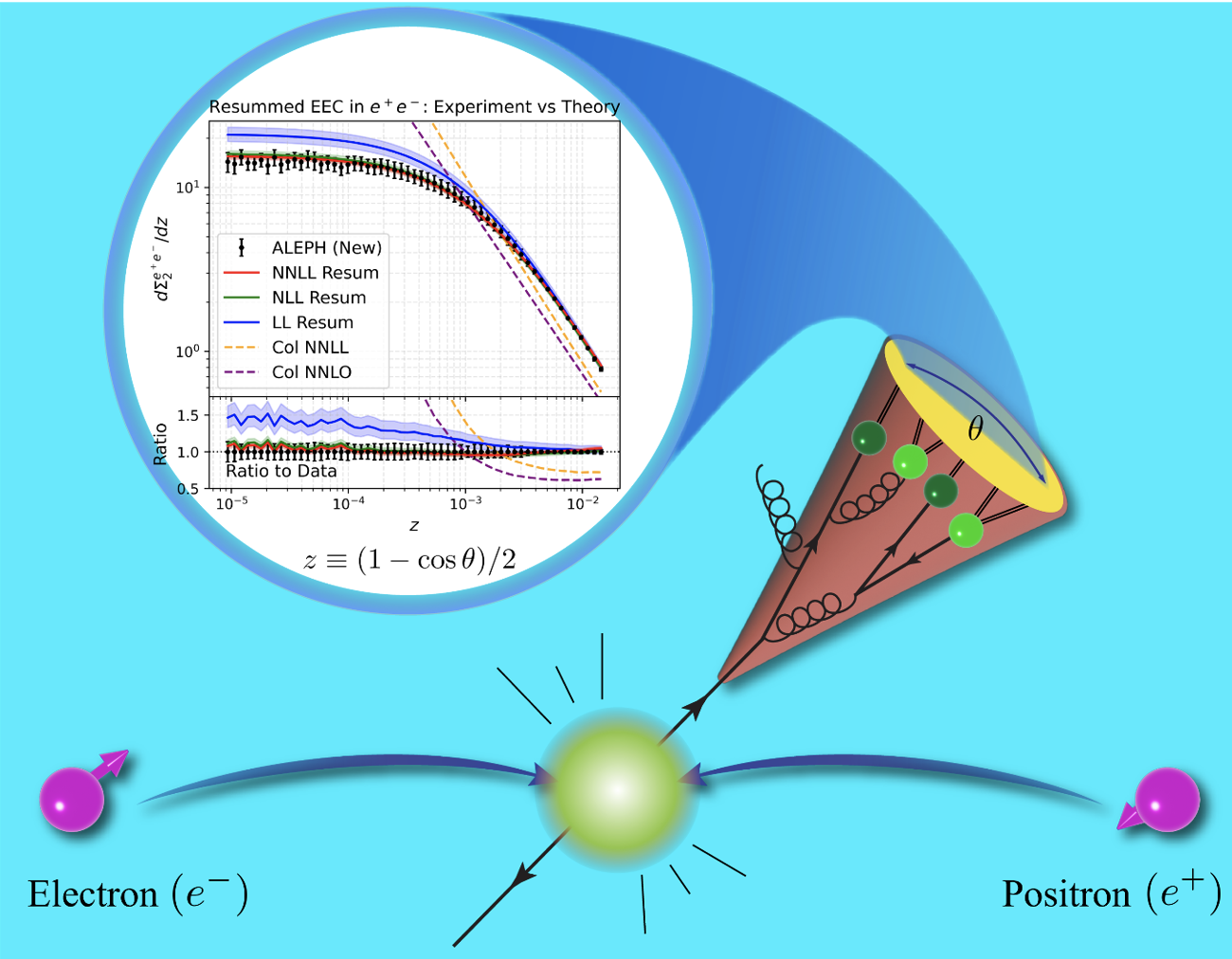
Phenomenology analyses based on these developments provide an excellent description of nearside EECs across a wide range of energy for all collision systems [6] (see figure). These results will also play an important role in the study of the hot QCD matter effects of EECs in heavy ion collisions. In particular, to disentangle different mechanisms the NSD scientists propose a correlation measurement that compares the full EECs with those constructed from two energy flows with different alignments with the jet axis [8]. This comparison demonstrates that genuine correlations exist for small angle and moderate/large angle, indicating that they are coming from correlated splitting. This insight will help to expose the medium modification of parton splitting in hot QCD medium.
References
[1] Basham C. L., Brown L. S., Ellis S. D., and Love S. T., Phys. Rev. Lett. 41, 1585 (1978).
[2] Moult I., Zhu H.-X., arXiv: 2506.09119.
[3] Liu X., Vogelsang W., Yuan F., and Zhu H.-X., Universality in the Near-Side, Energy-Energy Correlator, Phys. Rev. Lett. 134, 151901 (2025).
[4] Fan W., Jacak B., et al., ALICE Collaboration, arXiv: 2409.12687.
[5] Chang C.-H., Chen H., Liu X., Simmons-Duffin D., Yuan F., and Zhu H.-X., Quantum scaling in energy correlators beyond the confinement transition, Phys. Rev. Lett. 136, 081903 (2026).
[6] Guo Y., Yuan F., and Zhao W., Factorization and resummation for the nearside energy-energy correlators, Phys. Rev. Lett. 136, 081904 (2026).
[7] Guo Y., Yuan F., Vogelsang W., and Zhao W., Energy-Energy Correlators in e+e− annihilation and Deep Inelastic Scattering, Phys. Rev. D 113, 074027 (2026).
[8] Zhao W., Koch V., and Yuan F., Particle Correlations in Jets, arXiv: 2507.18790.
