
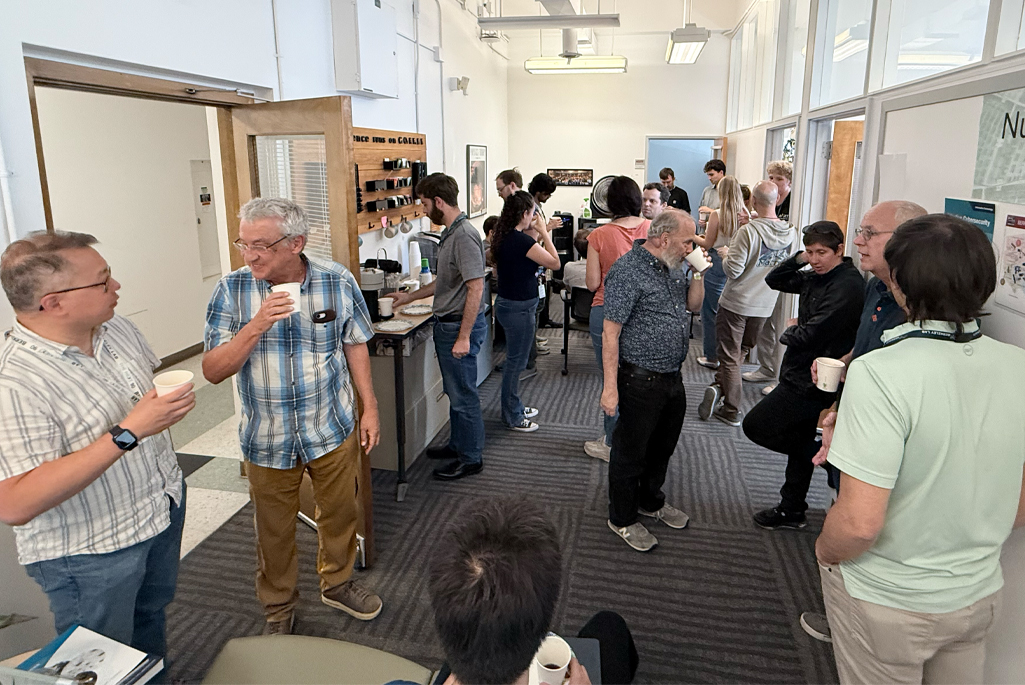
This summer, the Nuclear Science Division hosted a dozen interns from across the country, who contributed to a range of Berkeley Lab projects covering topics in experimental nuclear physics, data science, and theory. The internships provided undergraduate students with an opportunity to enhance their research skills and experience how collaborative science is done at a national laboratory.
Scientists in NSD served as mentors for the interns. In the Neutrinos Program, Zichen Wang, a physics major from UNC Chapel Hill, worked with Alan Poon and Marcos Turqueti on characterizing low-noise electronics for radiation detection for the LEGEND experiment. “I really like working at Berkeley Lab,” Wang said, “because people here are really passionate about their projects, and the projects here are working on solving real-world problems.”
Aidan O’Donnell from Louisiana State University worked with Mark Bandstra in the Applied Nuclear Physics Program. Aidan is studying computer science at LSU, and during his internship he worked on applying machine-learning tools to anomaly detection to improve the ability to detect radiation sources in urban environments. “I like nuclear science because it makes you feel like you have an impact on national security and that what we are doing is actually making a difference, in one way or another, in making our nation safe.” O’Donnell said.
Rohan Reddy, a nuclear engineering student from UC Berkeley, worked with Jacklyn Gates and Rodney Orford in the Low Energy Nuclear Physics Program, developing code for a device that would prepare a californium target for experiments attempting to synthesize element 120. At the 88-Inch Cyclotron, Brandon Osborne, an undergraduate from Purdue University, worked with Daniel Cheng on the development of MARS, the Lab’s next-generation ion source.
Derian Mowen, a Nuclear Engineering student from UT San Antonio with a background in Computer Science, worked with Ren Cooper and Mark Bandstra in the Applied Nuclear Physics Program to develop machine learning methods for radiological anomaly detection and isotope identification.
Shagan Juthani (UC Berkeley) worked with Andre Walker-Loud in the Nuclear Theory Program. Running and analyzing lattice QCD calculations in support of theory projects such as precision tests of the Standard Model.
In the Neutrinos Program, Winston Cho (UC Berkeley) and Gautam Ramkumar (UC Berkeley) worked with Ann-Kathrin Schuetz on using AI to automate the workflow in detector simulations. Persephone Choi (UC Berkeley) worked with Alex Lindman on using NERSC computing to simulate atomic interactions of relevance for designing an atomic tritium source.
Interns praised the Bay Area summer weather, the glorious views from the Lab, and the fun they had hanging out with new friends in the Nuclear Science Division. But what stood out was the singular scientific experience. “Ever since I was nine years old, when I first heard the idea of creating new elements, that really fascinated me,” said Rohan Reddy. “To be working as part of a team that is discovering those new elements now would just make nine-year-old Rohan very happy.”
