
The strong nuclear force between protons and neutrons emerges as a relatively small residual interaction that arises from the fundamental interactions between quarks and gluons that binds them into the nucleons we observe. Understanding the structure and interactions of nucleons in terms of their constituent quark and gluon degrees of freedom requires the use of high-performance-computing and a method known as lattice QCD.
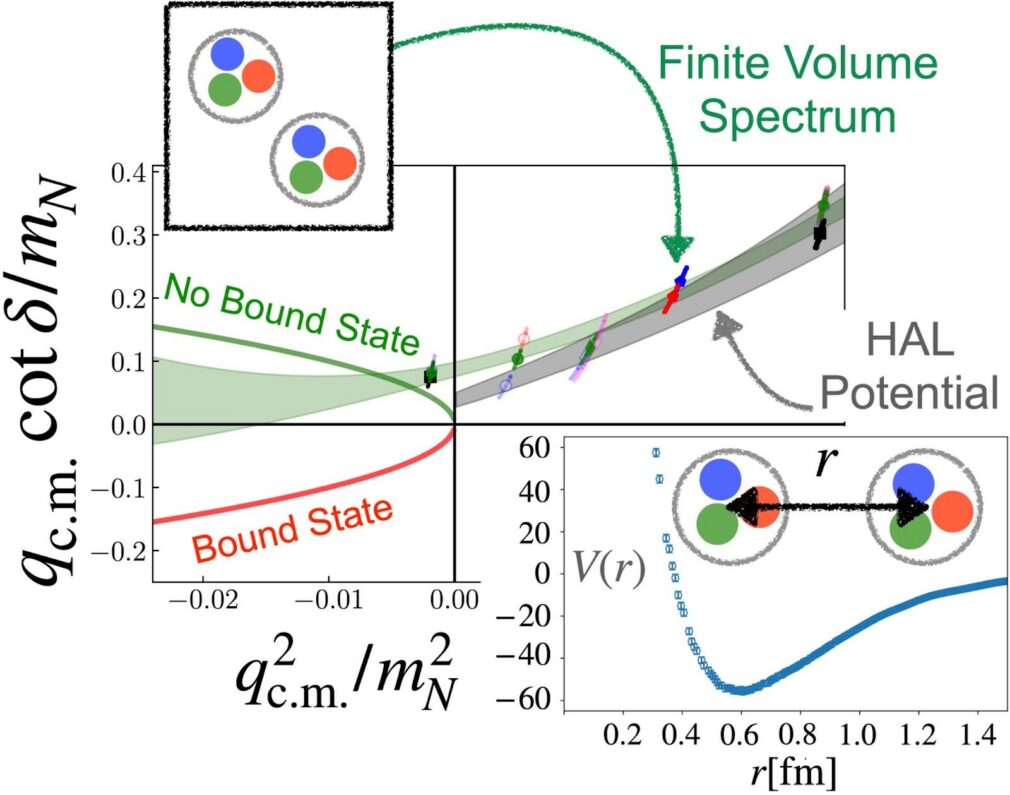
In lattice QCD, spacetime is discretized on a finite lattice, where the lattice spacing regulates the short-distance behavior of QCD. Lattice QCD is formulated in imaginary time (Euclidean spacetime) such that Monte Carlo methods can be used to evaluate physical properties of QCD eigenstates, such as the proton and neutron. In order to compute the scattering amplitude of two nucleons, a quantization condition is used to relate the finite-volume spectrum of two nucleons – which can be evaluated with lattice QCD – and the scattering phase shifts. A major challenge of this method is that a precise and accurate determination of the small residual energy is required. For the deuteron, this interaction energy is a part per mille. These challenges led to a 15 year discrepancy in the literature, depending upon the method used to compute the di-nucleon systems, on whether or not they bind at heavy pion mass.
In [1], André Walker-Loud and collaborators, including Ken McElvain (UC Berkeley), Joseph Moscoso (former SCGSR student at LBNL), and Ermal Rrapaj (NERSC), resolved this discrepancy. In order to do so, the lattice QCD calculation was performed on the same data set, with all methods in the literature, such that the systematic uncertainty associated with the method could be isolated. It was determined that old calculations led to a false determination of the two-nucleon spectrum in finite-volume due to shortcomings of the method, which led to the prediction of bound di-nucleons. It was also determined that a newer potential method was, in fact, correct and consistent with a proper method of determining the spectrum. The work represents a significant step towards deriving nuclear physics from first principles by paving the way for calculations with near-physical pion masses. An interesting next question to answer is, at what pion mass will a deuteron bound state form? Preliminary results from new lattice QCD calculations suggest it is in the vicinity of a pion mass of 200 MeV.
References
[1] Bulava et al., Di-nucleons do not form bound states at heavy pion mass. Phys. Rev. C 113, 024002(2026). DOI:10.1103/d2hg-h6d4, Editor’s Suggestion
