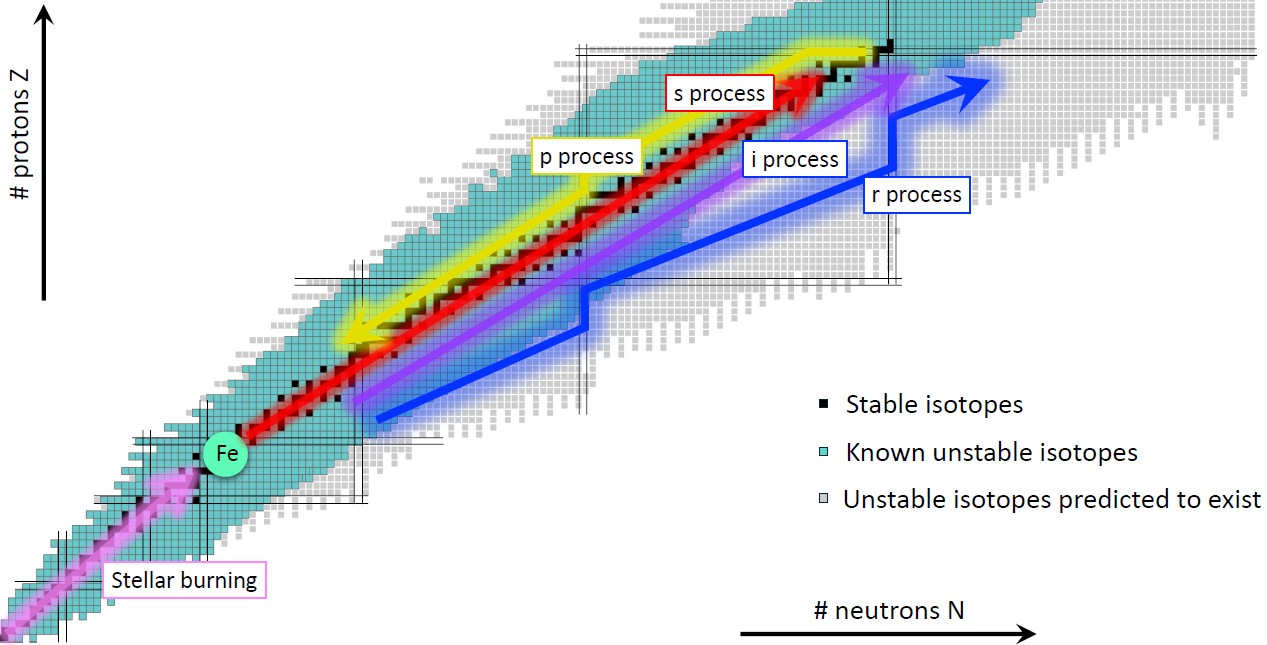
Where do the heavy elements around us come from? For decades, scientists have relied on two main processes to explain how stars build the heaviest elements. Yet a growing number of observations did not fit into this picture.
A recent Nature Reviews Physics article [1] led by the Nuclear Data Program of the Nuclear Science Division at Lawrence Berkeley National Laboratory reviews the missing piece: the intermediate neutron-capture, or i process. This mechanism bridges the gap between the well-known slow and rapid neutron-capture processes and helps explain puzzling element patterns seen in stars.
The i-process occurs under extreme stellar conditions. Hydrogen is mixed into hot helium-burning regions, triggering a chain of reactions that produces bursts of neutrons. These neutrons are captured by atomic nuclei, creating heavy elements along a pathway that differs from traditional neutron-capture processes.
Observational evidence for the i-process is growing. Astronomers have identified unusual element ratios, for instance in carbon-enhanced metal-poor stars and in rapidly evolving stellar systems such as the peculiar star known as Sakurai’s object. These findings suggest that the i-process may be a common contributor to the chemical evolution of the universe.
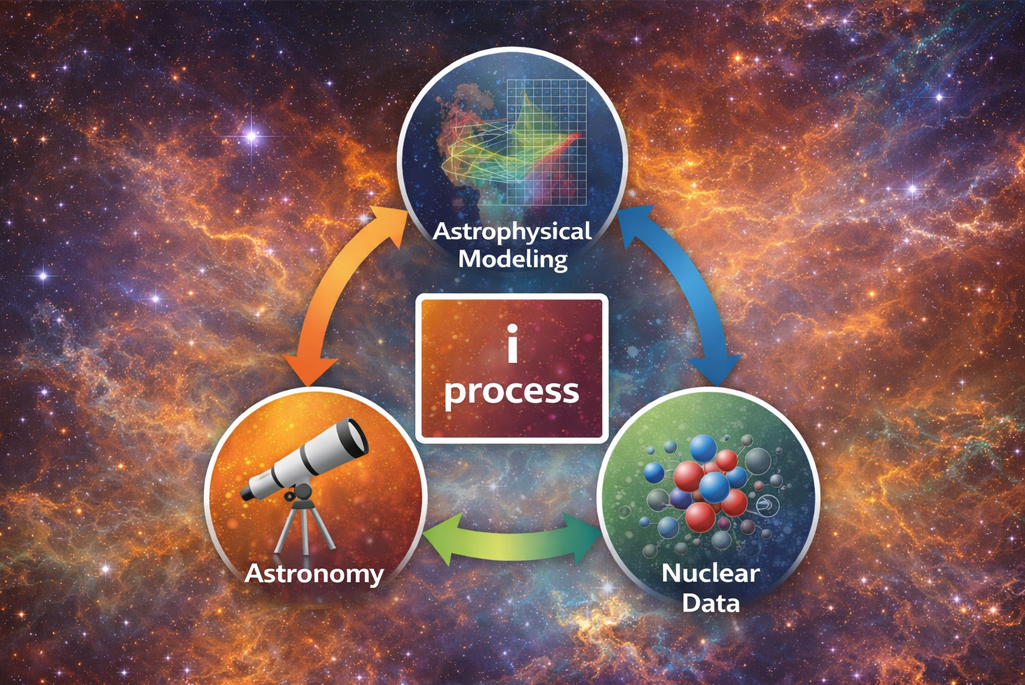
Understanding this process requires precise nuclear data. Many of the key reactions involve unstable nuclei that cannot be measured directly. To address this, researchers in the Nuclear Science Division and partner institutions are addressing this challenge by applying indirect techniques to constrain neutron-capture rates. These measurements, combined with improved models and astrophysical simulations, reduce uncertainties in element production.
This work directly supports the Nuclear Data Program mission. By improving nuclear data for neutron-capture reactions, it enables more accurate models of astrophysical processes and strengthens connections between basic science and applications.
References
[1] Unlocking i-process nucleosynthesis by bridging stellar and nuclear physics, M. Wiedeking, S. Goriely, M. Guttormsen, F. Herwig, A.-C. Larsen, S.N. Liddick, D. Mücher, A.L. Richard, S. Siem, A. Spyrou., Nature Reviews Physics 7, 696 (2025).