
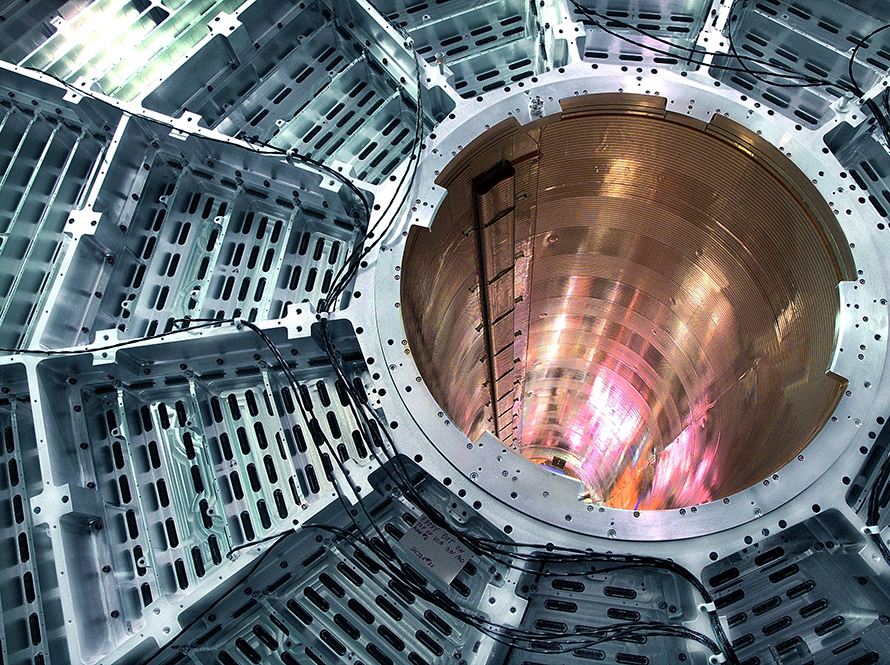
NSD researchers, led by staff scientist Javier Caravaca Rodriguez, were recognized with a 2026 R&D 100 Award for their work on Time of Flight Cascade Gamma Ray Imaging (TOF-CGI). The R&D 100 award recognizes the year’s 100 most innovative and disruptive technology products from industry, academia, and government-sponsored research. The TOF-CGI technology generates images of very low concentrations of radionuclides that emit gamma rays, with the possibility of improving nuclear medicine scanners and advanced therapies.

NSD scientists are playing leadership roles in several projects in the Genesis Mission, the DOE’s major initiative to advance science through advanced computing and artificial intelligence. Alan Poon is the LBNL partner PI on the Phase I project Enabling Rare Event Discovery with Surrogate Modeling and Simulation AI Agents, which is building AI surrogate models and agent-based workflows to accelerate detector simulations for rare-event searches such as LEGEND-1000. Brian Fujikawa is the LBNL partner PI on the Phase I project Denoising Quantum Sensors: Agentic Algorithm Creation and Real-Time AI for Quantum-Enabled Rare Event Discovery, which is using AI agents to improve the extraction of rare events from quantum sensors.
Other NSD scientists are contributing to complementary projects that provide data and methods for Genesis. Mario Cromaz leads the AI/ML-Ready Data Labeling for Low Energy Nuclear Physics project, which is curating nuclear physics datasets for use in machine-learning models. Mateusz Ploskon is a co-investigator on Preparing QCD Data for Foundation Models, which aims to standardize quantum chromodynamics data for use in AI models. Peter Jacobs leads the Bayesian Probabilistic Methods to Enable Cross-Cutting AI Research in Nuclear Science project, which is developing methods to make AI-based scientific inference more useful in nuclear science.
NSD scientist Joanna Szornel and her team have fabricated and delivered the high-purity germanium detectors that will fly on the Compton Spectrometer and Imager (COSI). The COSI mission, scheduled to launch in 2027, will study the production of heavy elements in our Galaxy by detecting gamma-rays from radioactive decay, and map the distribution of anti-matter through positron-electron annihilations.. The germanium detectors are the “eyes” of the instrument, offering precise measurements of the energy and direction of incoming gamma-rays.
The Gamma-Ray Energy Tracking Array (GRETA) has come online and is fulfilling its high expectations. Developed at Berkeley Lab, GRETA is the world’s most advanced gamma-ray spectrometer, offering scientists a tool to study atomic nuclei in unprecedented detail. Following successful commissioning at the Facility for Rare Isotope Beams (FRIB) at Michigan State University, the first experiments using GRETA have been carried out, revealing changes in the shape of atomic nuclei that may challenge existing theories.
In June, LBNL hosted The International Workshop on Quantitative Challenges in Short-Range Correlations (SRC) and the EMC-Effect Research. The workshop brought together an international community of experimentalists and theorists who study nuclear quantum many-body systems and how SRCs contribute to the understanding of the nuclear many-body wave function, provide sensitivity to the nuclear interaction, and impact nucleon degrees of freedom. The local LBNL organizers Julian Kahlbow, Dorothy Kenlow, Shujie Li, and Michele Anne.
LBNL scientists also helped to hold the 2026 International Symposium on Capture Gamma-Ray Spectroscopy and Related Topics. The program emphasized topics in gamma-ray spectroscopy and its role in studies of nuclear structure, nuclear reactions, nuclear astrophysics, fundamental interactions, and symmetries. Heather Crawford and Mathis Wiedeking were conference co-chairs, and the local organizing committee included many other NSD members.
