
Lattice QCD is the only framework that provides systematically improvable predictions of fundamental hadron structure properties in the non-perturbative energy regime of QCD. However, the crucial case of the PDFs, which encode the longitudinal distribution of momentum within hadrons, remains particularly challenging due to technicalities related to the geometry and symmetries of the discretized theory: the reduced, discrete rotational symmetry of the lattice allows operators that are independent in the continuum with full rotational symmetry to mix in the lattice calculations. For all but the lowest moments, this mixing diverges in the continuum limit.
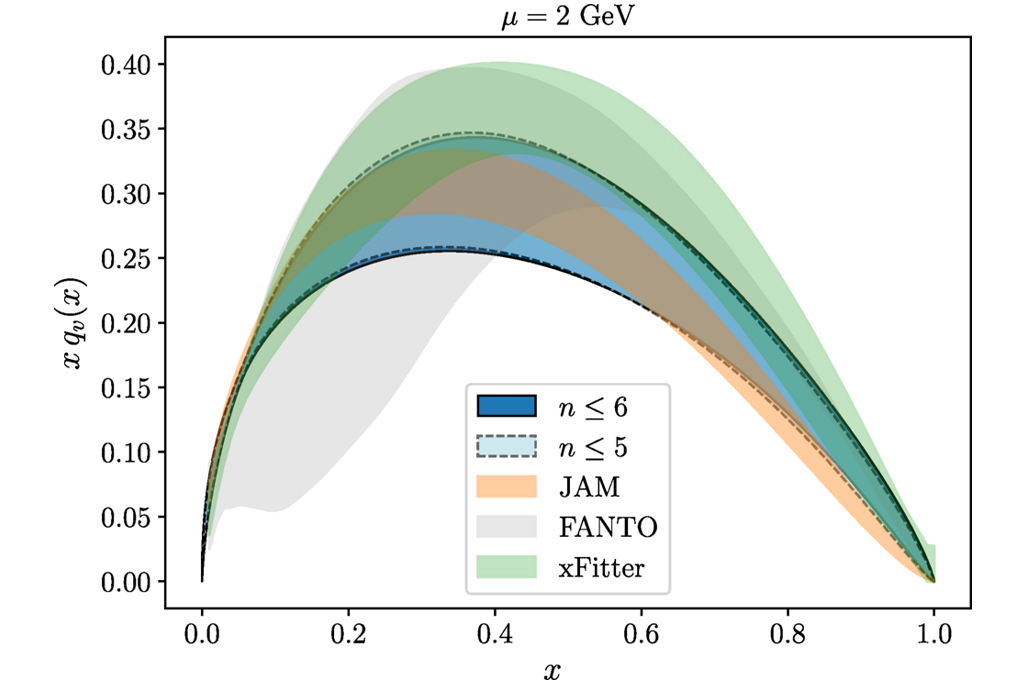
This study utilizes a novel method, originally proposed by Shindler, that employs the gradient flow to circumvent this power-divergent mixing problem. Through a controlled numerical implementation using four different lattice spacings, the efficacy of this approach is demonstrated up to the sixth Mellin moment of the pion’s valence PDF. Furthermore, a simple reconstruction of the PDF from these moments yields a distribution consistent with phenomenological extractions from experimental data.
The success of this approach highlights its potential to provide high-precision theoretical input for hadron structure, which is critical for measurements at current and future facilities like Jefferson Lab and the Electron-Ion Collider. While this initial application serves as a proof-of-principle, it establishes a robust framework and can be extended in the future to address the proton PDFs and generalized parton distributions. This method is complementary to existing techniques, and provides first-principles lattice QCD results that can in the future be directly incorporated into global PDF analyses. The lattice QCD results were partially computed on Perlmutter at NERSC.
Read the main result article [Phys.Rev.Lett. 136 (2026) 17, 171903] and its companion article with more details, [Phys.Rev.D 113 (2026) 7, 074520].
